The Beale Treasure
In 1885, an anonymous pamphlet printed in Lynchburg claimed that a man named Thomas J. Beale had buried gold, silver, and jewels in Bedford County around 1820, and left the directions in three numbered ciphers. Only one cipher has been read, using the Declaration of Independence as its key, and it lists the contents but not the spot. The other two have held for 140 years, and the diggings around Montvale have turned up nothing.
Search Area
loading map…
- Start point
- Peaks of Otter Winery and Johnson's Orchard
- Visitor access
- Peaks of Otter Winery, 1218 Elmos Rd, Bedford, VA 24523
- Measured from
- Montvale, once Buford's Tavern
- Search zone
- About 4 miles around Buford's
- Parking
- At the winery, and at the Peaks of Otter about 20 minutes north
- Nearest town
- Montvale, Virginia
A general search zone, not an exact site. Buford's Tavern, now the town of Montvale, is the fixed point every account is measured from.
The Legend
In 1885, a 23-page pamphlet went on sale in Lynchburg, Virginia, for 50 cents. It told of a man named Thomas Jefferson Beale. In the winters of 1819 and 1821, the pamphlet says, Beale buried a fortune in gold and silver "about four miles from Buford's" in Bedford County. He then left three sheets of numbered ciphers with a local innkeeper, Robert Morriss, and disappeared for good.
Beale had supposedly written that a friend would mail Morriss the key. It never came. Morriss held the box for decades, opened it, and could make nothing of the numbers. The pamphlet's unnamed author says he inherited the papers from Morriss and spent years on them before cracking the second sheet.
The break was the second cipher's key: the United States Declaration of Independence. Numbering the words of the Declaration and reading the first letter of each numbered word turns sheet two into plain English. It opens, "I have deposited in the county of Bedford, about four miles from Buford's, in an excavation or vault, six feet below the surface of the ground." It then lists the haul. Sheet one, which gives the location, and sheet three, which names the heirs, use keys that no one has found.
The pamphlet made the story famous and left the hardest part unsolved. Buford's Tavern is now the town of Montvale, and for 140 years people have come to the hills around it with shovels, metal detectors, and their own readings of sheet one. The holes are real. The gold has never turned up.
What May Be Out There
Sheet two, the one that has been read, is specific about the contents. Whether any of it exists is the open question.
- 2,921 pounds of gold and 5,100 pounds of silver, buried in two loads in November 1819 and December 1821.
- Jewels the pamphlet values at $13,000 in the money of the day, bought in St. Louis in exchange for silver.
- A rock-lined vault six feet down, with iron pots under flat stones.
- Recovered so far: nothing that has been shown to be Beale's.
At gold's 2024 price the metal alone would be worth around $96 million. That figure assumes the pamphlet is telling the truth, which is the whole dispute.
The Evidence
Documented record
- The 1885 pamphlet itself, printed by James B. Ward in Lynchburg, with all three ciphers reproduced in full.
- The second cipher decodes cleanly against the Declaration of Independence. Anyone can check it.
- More than a century of newspaper coverage of searchers, permits, and dug-up fields in Bedford County.
Legend and hearsay
- Thomas J. Beale himself. No record outside the pamphlet has been matched to him.
- The letters from Beale to Morriss, quoted in the pamphlet but never produced.
- The claim that a friend in St. Louis held the key and then vanished.
Known Clues
The second cipher, solved. Read against the Declaration of Independence, it gives the contents and the phrase "four miles from Buford's," but not the exact spot. Credible as a decoding, silent on location.
The first cipher, unsolved. This is the sheet that supposedly gives the location. In 1980, the cryptographer Jim Gillogly ran it against the Declaration. Instead of random letters he got strings like "abfdefghiijklmmnohpp," long alphabetical runs that no plain message produces. One reading calls that the fingerprint of a hoax. Another calls it a second key nobody has found.
The hand behind the pamphlet. Analysts have found period-wrong words in the text. Joe Nickell's 1982 study argued the writing is James B. Ward's own, which would make Beale a character and the ciphers a puzzle Ward built.
Visiting Information
The search area sits around Montvale and the foot of the Peaks of Otter, west of Bedford. Two working farms welcome visitors: Johnson's Orchard and the Peaks of Otter Winery, on Elmos Road in Bedford, open through the week with shorter winter hours. It is worth calling ahead in January and February, when hours drop to weekends.
The Peaks of Otter, including Sharp Top, are on the Blue Ridge Parkway about 20 minutes north, with parking, a lodge, and trails around Abbott Lake.
The surrounding land is private and mostly farmed. Searching or digging anywhere here needs the landowner's permission, and the county has a long history with uninvited treasure hunters. The best of the story is free: the 1885 pamphlet is out of copyright and online.
Reality Check
A real pamphlet exists, and its second cipher does decode against the Declaration of Independence. Everything else rests on that one anonymous document. No record outside the pamphlet has been matched to Thomas J. Beale, and the letters he is said to have sent Robert Morriss were never produced. The sheet that would give the location has never decoded into words. Jim Gillogly's 1980 attempt on it returned long alphabetical runs that read more like a constructed puzzle than a message. The diggings around Montvale are documented. The gold is not.
Field Gallery
No approved field photos yet. You could be first.
Community Notes
No community notes yet.

The Greenbrier Bunker
43 miCongress built itself a fallout shelter under a luxury resort between 1958 and 1961, hidden behind the construction of a new hotel wing, with dormitories for 1,100 people and chambers for the House and the Senate. Staff maintained it under cover of a television repair company for 30 years. It stayed secret until Ted Gup published it in The Washington Post on May 31, 1992.

The Greenbrier Ghost
49 miOn February 22, 1897, doctors exhumed Zona Heaster Shue and found her neck dislocated between the first and second vertebrae and her windpipe crushed. Her husband, a blacksmith known as Trout Shue, was convicted of her murder in this courthouse that summer and sent to prison for life. The ghost entered the trial only when his own lawyers cross-examined her mother, Mary Jane Heaster, who testified that Zona had come to her on four nights and told her how she died.

Lake Shawnee Amusement Park
79 miAn amusement park that opened in 1926 on Mercer County land where a settler family had been attacked in 1783, closed after a girl was killed on the swing ride, and was later found to be sitting on a Native American burial ground. The swing frame and the ferris wheel are still standing in the grass, and the family that owns the land runs tours by appointment.
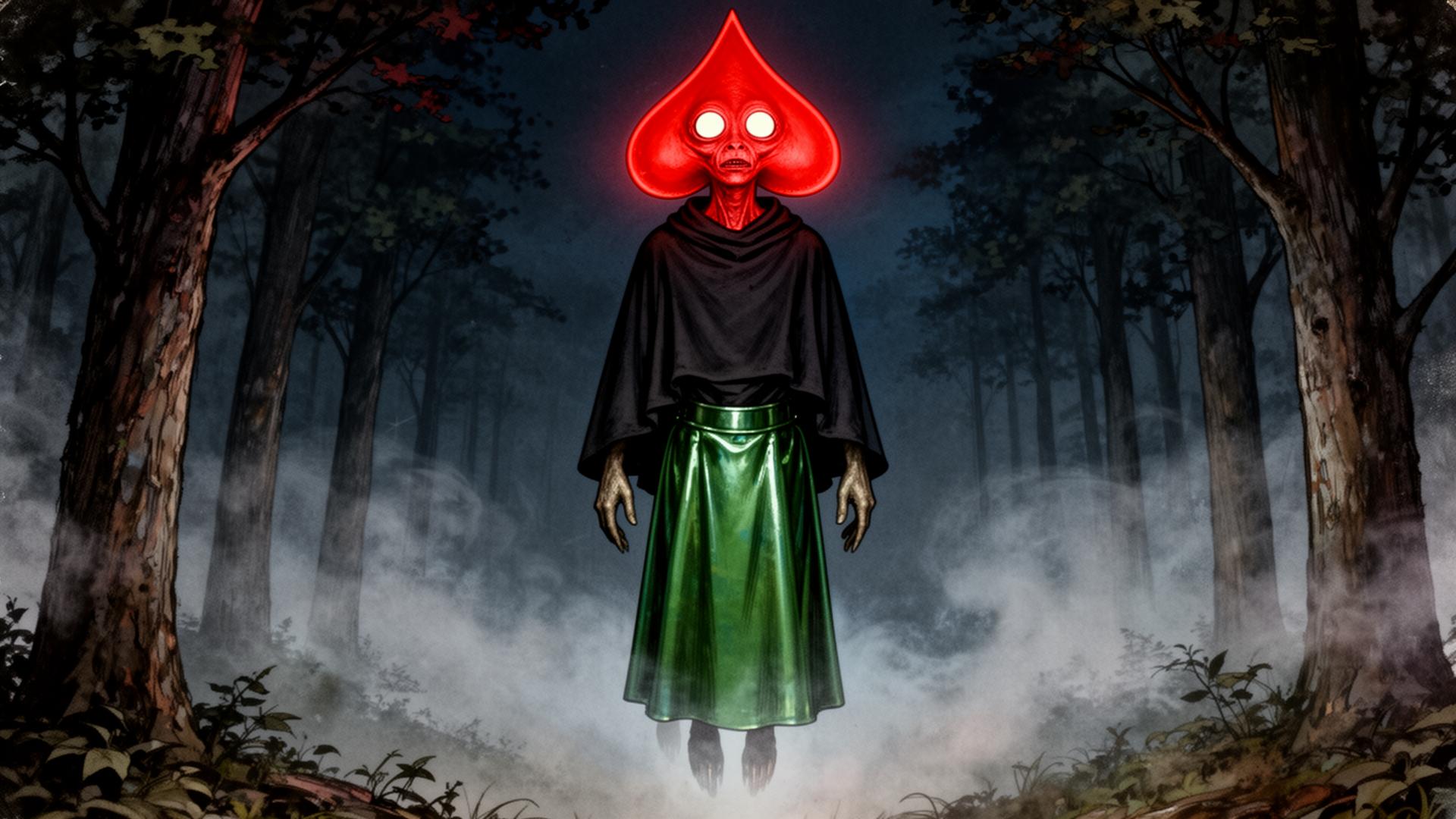
The Flatwoods Monster
105 miOn the evening of September 12, 1952, a group of boys, a mother named Kathleen May, and a 17-year-old National Guardsman walked up a hill outside Flatwoods to look at something that had come down. Braxton County has since built a free museum and a set of giant monster chairs on what they said they saw.