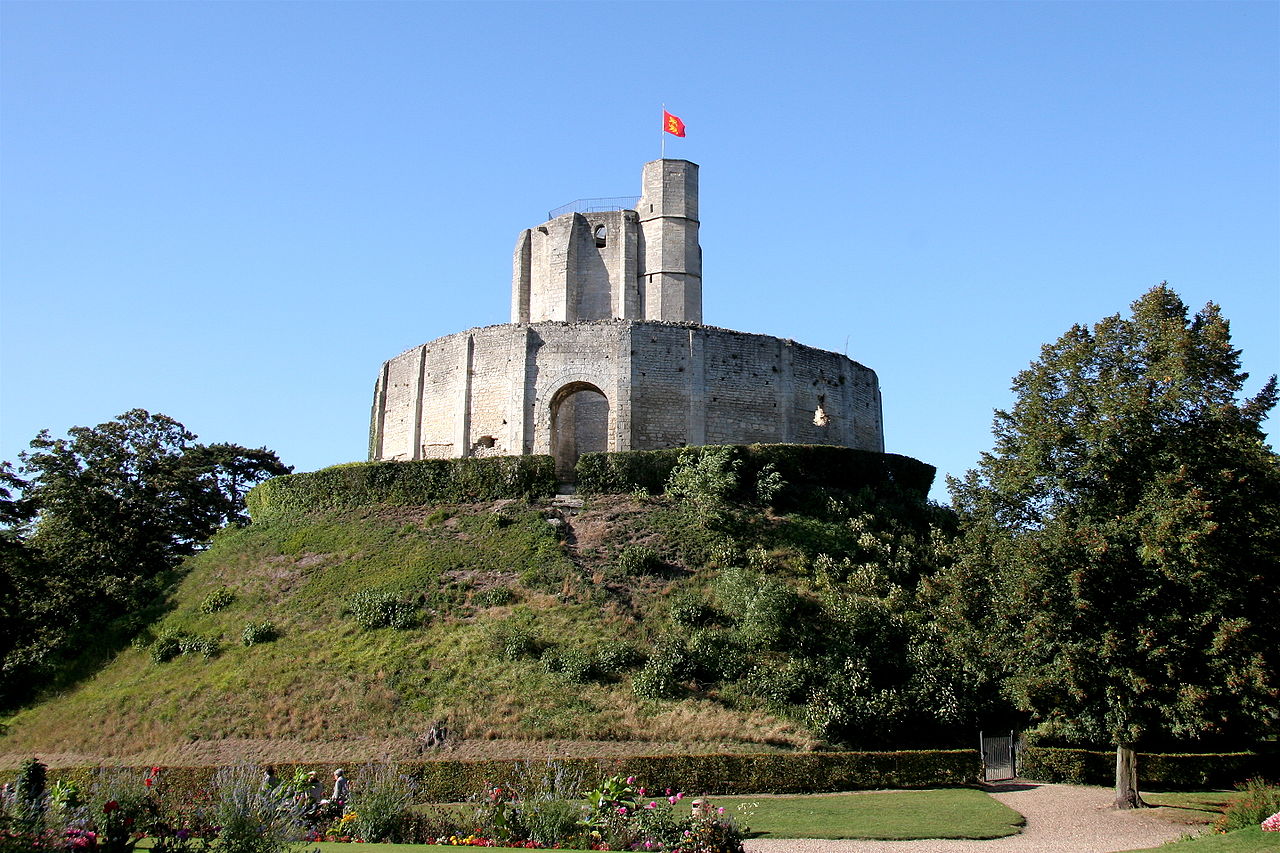
Château de Gisors
In March 1946, the castle's gardener walked into the town hall at Gisors and reported what he said he had found after years of digging under the castle mound at night: a stone chapel underground, sarcophagi along its walls, and 30 metal chests stacked in the nave in columns of 10. His tunnel was filled in. France's culture minister sent official excavators in the 1960s and they found nothing at all.
Search Area
loading map…
- Start point
- Château de Gisors, in the middle of the town
- Visitor access
- Château de Gisors, 27140 Gisors, Eure
- Measured from
- The feudal mound at the center of the castle enclosure
- On foot
- The park is entered directly from the town streets
- Access underground
- Only on the guided tour, which goes into the cellars beneath the mound
- Nearest town
- Gisors, Eure
A general search zone, not an exact site. The mound at the center of the enclosure is the fixed point every version of the story is measured from.
The Legend
The castle at Gisors was a Norman border fortress, built to hold the frontier between Normandy and the French king's lands. The Knights Templar held it for a period in the 12th century. That is the whole of the documented connection between Gisors and the Templars, and it is the seed of everything that came after.
Roger Lhomoy was the castle's gardener and caretaker. Convinced that something was buried under the feudal mound, he dug at night, alone, for years. In March 1946, he came to the town hall with an account of what he said he had reached: a Romanesque chapel underground, stone sarcophagi set along the walls, and 30 metal chests stacked in the nave in columns of 10.
The tunnel was declared unsafe and filled in. Lhomoy never brought out a single object from it, and nobody else ever saw the chapel he described.
The story would have ended there. It did not, because the writer Gérard de Sède published it in 1962, and André Malraux, then France's minister of culture, ordered official excavations at the castle. They ran into the mid 1960s. They found no chapel and no chests.
The castle is open today, and the guided tour goes down into the cellars beneath the mound Lhomoy spent six years digging into.
What May Be Out There
Everything claimed for the site rests on one man's account of one night's discovery.
- A Romanesque chapel under the feudal mound, described by Lhomoy and seen by nobody since.
- 30 metal chests, said to be stacked in columns of 10.
- Stone sarcophagi set along the chapel walls.
- Recovered so far: nothing, across two official excavations.
The Evidence
Documented record
- The castle's genuine Templar tenure in the 12th century.
- Lhomoy's report to the Gisors town hall in March 1946, and the filling of his tunnel.
- The official excavations ordered by André Malraux in the 1960s, and their negative result.
- The medieval graffiti carved into the walls of the Prisoner's Tower, which visitors can still see.
Legend and hearsay
- The claim that the Templar treasure was moved to Gisors before the order was suppressed.
- The chapel, the sarcophagi, and the 30 chests, none of them ever produced or photographed.
- The Priory of Sion material that later attached itself to the site.
Known Clues
The Prisoner's Tower. The graffiti cut into its walls by prisoners is real, medieval, and on the standard tour. It is the one thing at Gisors that is old, strange, and still there.
Lhomoy's six years. He dug at night for years without being stopped, which tells you something about how loosely the mound was watched, and produced nothing portable, which tells you something else.
Malraux's excavations. A sitting culture minister putting state excavators into a castle on the strength of a gardener's story is the most remarkable fact in the case. They dug. There was no chapel.
Visiting Information
The castle park is free and open all year, from 9am to 5pm between October and March and until 7:30pm from April to September. It is entered directly from the streets of Gisors.
The keep, the Prisoner's Tower with its medieval graffiti, and the cellars beneath the feudal mound are reached only on a guided tour. Tours run from April 15 to October 30 at 10am, 2pm, and 5pm and last about 90 minutes, with tickets at 9 euros and a reduced rate of 4 euros. Children under 12 go free and children under 6 cannot join the tour. Groups are capped at 18 people, so it is worth booking ahead and confirming availability with the castle office.
The monument has more than 300 steps along with slopes and narrow staircases, so sturdy footwear helps. Gisors is on the rail line from Paris and the castle is a short walk from the station.
Reality Check
A real castle, a real Templar tenure, and a real man who dug under it for years. Past that the case is one unverified account. Lhomoy produced no object, no photograph, and no witness, and when the French state sent its own excavators after him they came back with nothing. What survives at Gisors is worth the visit on its own: a border fortress, a keep, and prisoners' graffiti cut into the stone. The chapel with the 30 chests has never been seen by anyone but the man who reported it.
Field Gallery
No approved field photos yet. You could be first.
Community Notes
No community notes yet.

Louvre Crown Jewels Robbery
39 miAt 9:34am on October 19, 2025, two men in yellow vests forced the balcony window of the Galerie d'Apollon at the Louvre, cut into two display cases with angle grinders, and left 4 minutes later with eight pieces of the French crown jewels. A ninth object, Empress Eugénie's crown, was left on the escape route and recovered damaged. The museum's curator put the loss at 88 million euros, and the eight pieces had not been reported found as of October 2026.

Shell Grotto
147 miOn May 12, 1838, a Kent newspaper reported that workmen digging at Belle Vue Cottage in Margate had struck "a large stone" and found under it a grotto "completely studded with shells." The chalk passages run about 70 feet to a rectangular chamber lined, by the owners' estimate, with 4.6 million shells. Nobody knows who made it or when. The Grade I listing calls it most likely early 19th century, and a 2005 survey proposed a medieval chalk mine, probably reworked in the 1700s. The schoolmaster's daughter said her brother had crawled in before the official find.

The Just Judges Panel, St Bavo's Cathedral
150 miOn June 14, 1934, a taxi driver collected a parcel holding 25,000 francs from an Antwerp rectory, a fraction of the 1,000,000 that an extortionist signing D.U.A. had demanded for two panels stolen from St Bavo's Cathedral in Ghent. The Saint John the Baptist panel was returned that year. The Just Judges panel of the Ghent Altarpiece never was, and the Ghent prosecutor's file on it was still open in January 2026.

Tower of London
174 miIn 1816, a sentry at the Jewel House reportedly bayoneted a bear-shaped apparition and died of shock days later. In October 1817, Edmund Swifte, Keeper of the Crown Jewels, said he threw a chair through a glowing, cylinder-shaped apparition in the same building.