
Louvre Crown Jewels Robbery
At 9:34am on October 19, 2025, two men in yellow vests forced the balcony window of the Galerie d'Apollon at the Louvre, cut into two display cases with angle grinders, and left 4 minutes later with eight pieces of the French crown jewels. A ninth object, Empress Eugénie's crown, was left on the escape route and recovered damaged. The museum's curator put the loss at 88 million euros, and the eight pieces had not been reported found as of October 2026.
Search Area
loading map…
- Start point
- The Louvre, first floor of the Denon wing
- Address
- Musée du Louvre, Quai François Mitterrand, 75001 Paris, France
- Measured from
- The Galerie d'Apollon
- Getting around
- On foot inside the museum
- What is here
- A gallery with its decoration and no display cases
- Nearest town
- Paris
The balcony the thieves used overlooks the Quai François Mitterrand. No search area is drawn for this one, because no source says where the objects are.
The Legend
The Paris prosecutor's office gave the times in a communiqué dated October 20, 2025. On Sunday, October 19, at 9:34am, half an hour after the Louvre opened, two men in yellow vests broke a window and entered the Galerie d'Apollon. They cut the glass of two display cases and took jewels from several of the collections shown there. At 9:38am they left by the same window and rode off on two scooters along the Seine embankment.
Two other men had come with them. Surveillance video showed all four arriving together with a lift mounted on a truck. Laurence des Cars, then the Louvre's president, told the Senate's culture committee on October 22 that the truck stood on the sidewalk of the Quai François Mitterrand with traffic cones around it, so the men in vests looked like a maintenance crew. The two who went in rode the lift up to the first-floor balcony.
What was taken
Nine objects were taken from the cases. The Ministry of Culture listed eight of them on the day of the theft: a diadem, a necklace, and an earring from the sapphire parure of Queen Marie-Amélie and Queen Hortense; a necklace and a pair of earrings from the emerald parure of Empress Marie-Louise; a brooch known as the reliquary brooch; Empress Eugénie's diadem; and her large corsage bow brooch. The prosecutor's list, a day later, reverses the earrings. It has a pair of sapphire earrings and a single emerald earring. Each list adds up to eight objects.
On October 21, 2025, the prosecutor, Laure Beccuau, told the radio station RTL that the Louvre's curator had put the loss at 88 million euros. That is the museum's estimate of the damage. The reports do not say whether it counts the crown.
The crown left behind
The ninth object was Empress Eugénie's crown. The prosecutor's communiqué lists it among the objects taken and says it was found damaged, soon afterward, on the escape route. The Ministry of Culture said the thieves left it behind.
Des Cars told the senators that the judicial police held the crown first and that the Louvre's department of decorative arts took it back on October 21. She said the damage probably came from pulling the crown out of the case, not from a fall, because the glass had held and the openings the thieves cut were very narrow.
Press accounts differ on whether anything has been recovered, and the difference is the crown. Counting it, one of the nine objects was recovered. Leaving it out, none of the eight that remain has been.
The way in
The balcony door was a door-window with 10 millimeter anti-intrusion glass and an electric lock at two points, installed in a restoration finished on November 27, 2004, according to des Cars. The alarm on it went off at 9:34am. A guard radioed the control room at 9:35am, and the police alert was triggered at 9:36am. The thieves were out at 9:38am.
What the audits found
The Cour des comptes, in a report on the museum's 2018 to 2024 accounts published in November 2025, found that the Louvre had favored highly visible projects over maintenance and technical systems, security among them. In 2024, 183 of its 465 galleries had at least one camera, about 39 percent.
The Ministry of Culture's inspectorate reported on October 31, 2025, that the museum had underestimated the structural risk of theft and intrusion for more than 20 years. Senators heard on December 10 that a 2019 audit of the gallery by the jeweler Van Cleef & Arpels, and a 2017 audit of the museum's security, had been annexed to that inquiry and that the museum had not acted on either. Des Cars said she had offered her resignation on the day of the theft and that the Culture Minister refused it. On February 25, 2026, the Ministry announced that she was leaving, and Christophe Leribault was named to replace her.
Where the case stands, October 2026
The prosecutor's office opened a judicial investigation on October 29, 2025, run by investigating judges of the interregional specialized court in Paris, with the Brigade de répression du banditisme and the Office central de lutte contre le trafic de biens culturels. By November 28, 2025, five people had been charged. The last was described in the prosecutor's communiqué as the man suspected of being the fourth person at the scene.
As of October 2026, none of the eight missing objects had been reported recovered, and no official statement had said where they are.
What May Be Out There
Eight objects left the Galerie d'Apollon on October 19, 2025, and had not been reported found as of October 2026. The two official lists differ on the earrings.
- A diadem, a necklace, and an earring from the sapphire parure of Queen Marie-Amélie and Queen Hortense, on the Ministry of Culture's list. The prosecutor's list names the pair of earrings.
- A necklace and earrings from the emerald parure of Empress Marie-Louise. The Ministry lists a pair of earrings; the prosecutor lists one.
- The brooch known as the reliquary brooch.
- Empress Eugénie's diadem.
- Empress Eugénie's large corsage bow brooch.
- Recovered: Empress Eugénie's crown, found damaged on the escape route the same day.
The Evidence
Documented record
- The Paris prosecutor's communiqués of October 20, October 26, November 25, and November 28, 2025, with the times, the list of objects, and the charges.
- The Ministry of Culture's communiqués of October 19 and October 31, 2025.
- The Senate culture committee's transcripts of the October 22, 2025, hearing of Laurence des Cars and the December 10, 2025, hearing of the heads of the ministry's inspectorate and security mission.
- The Cour des comptes report on the Louvre, November 2025.
- The entry of the stolen objects in INTERPOL's Stolen Works of Art database.
Claims and hearsay
- Any account of where the jewels are now. No official source has given one.
Known Clues
The grille. A grille protected the window at the end of the gallery, on the quay side, from the late 19th century until 2003, when it was taken out during the renovation so that firefighters could get in faster. Pascal Mignerey, of the Ministry of Culture's security and audit mission, told the Senate on December 10, 2025, that the question of the grille came up again in 2018 and 2019, when the display cases were replaced, and that nothing was done. The thieves went in through the balcony door-window at that end.
The camera. Des Cars told the Senate committee on October 22 that the only exterior camera on that side pointed west and missed the balcony. Noël Corbin, head of the ministry's inspectorate, told the same committee on December 10 that the one camera there, an analog fixed model, filmed the thieves arriving, setting up the lift, and climbing to the balcony, and that the control room had too few monitors to show the images in real time. The two statements, 7 weeks apart, disagree on what the camera saw.
The 30 seconds. Corbin said the thieves could have been stopped by 30 seconds. Louvre staff had told police about an intrusion in the Galerie d'Apollon without saying where, and the first police cars went toward the Carrousel and had to turn around.
The glass. The two cases held for nearly 3 minutes against portable grinders, Mignerey said. Bulletproof glass is built to resist sledgehammers, axes, and gunfire, he said, and portable grinders are not in the makers' standards.
Visiting Information
The Galerie d'Apollon reopened on July 22, 2026, after being closed since the theft. Press coverage of the reopening describes a gallery with no display cases and no jewels. It sits on the first floor of the Denon wing and connects the Apollo Rotunda to the Salon Carré.
The museum is open Monday, Thursday, Saturday, and Sunday from 9am to 6pm, and Wednesday and Friday from 9am to 9pm. It is closed on Tuesdays, January 1, May 1, and December 25, with last entry 1 hour before closing. As of October 2026, a ticket costs 22 euros for citizens and residents of the European Economic Area and 32 euros for other visitors, with free admission for under-18s and for EEA residents under 26. The Louvre recommends booking a time slot, including for free admission.
Reality Check
The theft is documented to the minute. The prosecutor's office gives 9:34am and 9:38am, the Ministry of Culture lists the objects, two Senate hearings and a national audit describe how the building was exposed, and five people were charged by the end of November 2025. What is not documented is where eight objects are. No official statement has named who ordered the theft or who received the jewels. In July 2026, the Louvre reopened the gallery with no display cases.
Field Gallery
No approved field photos yet. You could be first.
Community Notes
No community notes yet.
Nearby Strange Places
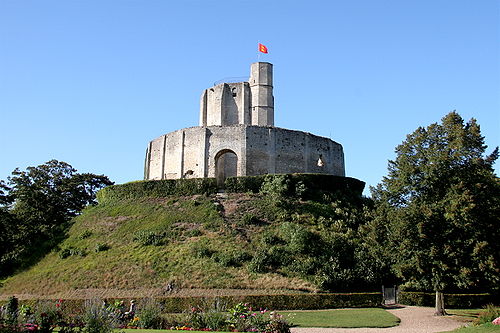
Château de Gisors
39 miIn March 1946, the castle's gardener walked into the town hall at Gisors and reported what he said he had found after years of digging under the castle mound at night: a stone chapel underground, sarcophagi along its walls, and 30 metal chests stacked in the nave in columns of 10. His tunnel was filled in. France's culture minister sent official excavators in the 1960s and they found nothing at all.

The Just Judges Panel, St Bavo's Cathedral
164 miOn June 14, 1934, a taxi driver collected a parcel holding 25,000 francs from an Antwerp rectory, a fraction of the 1,000,000 that an extortionist signing D.U.A. had demanded for two panels stolen from St Bavo's Cathedral in Ghent. The Saint John the Baptist panel was returned that year. The Just Judges panel of the Ghent Altarpiece never was, and the Ghent prosecutor's file on it was still open in January 2026.

Shell Grotto
180 miOn May 12, 1838, a Kent newspaper reported that workmen digging at Belle Vue Cottage in Margate had struck "a large stone" and found under it a grotto "completely studded with shells." The chalk passages run about 70 feet to a rectangular chamber lined, by the owners' estimate, with 4.6 million shells. Nobody knows who made it or when. The Grade I listing calls it most likely early 19th century, and a 2005 survey proposed a medieval chalk mine, probably reworked in the 1700s. The schoolmaster's daughter said her brother had crawled in before the official find.

Rochers sculptés de Rothéneuf
196 miFrom late 1894 to 1907, a priest named Adolphe Julien Fouéré, known as the Abbé Fouré, carved more than 300 figures into the granite cliffs at Rothéneuf, east of Saint-Malo: Breton saints, Jacques Cartier, the Boer president Paul Kruger, and sea monsters. The Saint-Malo tourist office says the figures tell the legend of the Rothéneuf family, "corsairs and pirates until the Revolution." The association that studies his work points to his newspapers and his guest book instead, and to a carving called the Rothéneuf Family with the abbé himself, crowned, at its center. A state inspection in 2009 called the site's condition alarming.