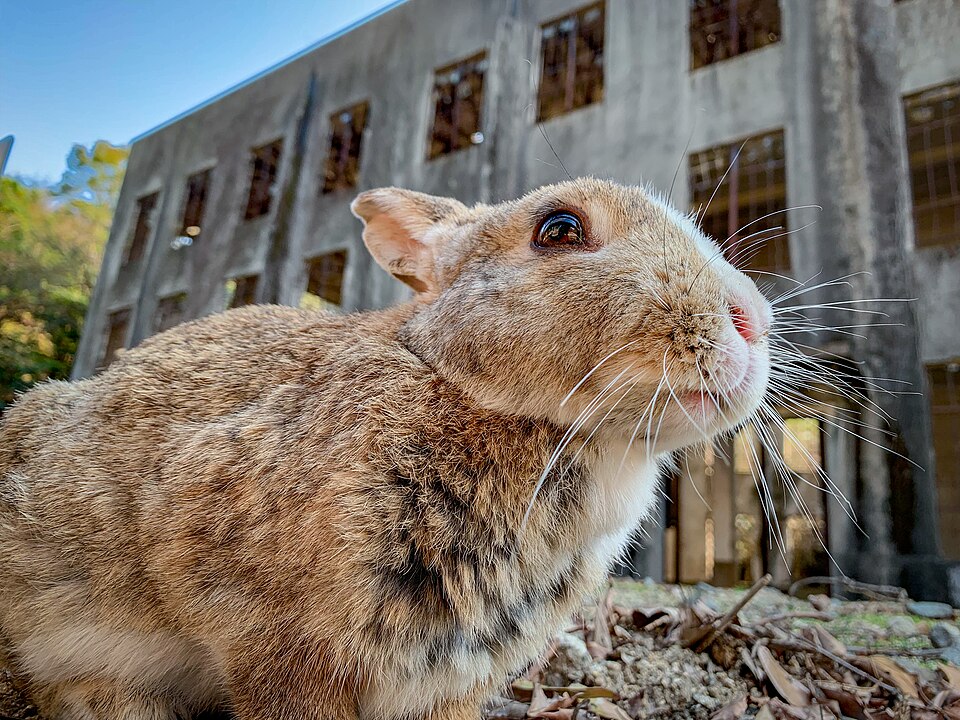
Okunoshima
For sixteen years, Japan erased this island from its own maps while a secret factory produced thousands of tons of poison gas there. Today it is overrun by tame rabbits, and the ruins still stand.
Field Guide Entry
Okunoshima is a small island in the Seto Inland Sea, a 15-minute ferry ride from the town of Tadanoumi. In 1929, the Imperial Japanese Army chose it for a chemical weapons plant precisely because it was small, isolated, and easy to hide: far enough from Tokyo to protect the capital, close enough to the mainland to supply. From then until 1945, the island was removed from official Japanese maps. Workers were sworn to secrecy, residents were relocated, and ferries passed an island that officially was not there.
Over sixteen years the plant produced more than 6,000 tons of mustard gas and other chemical agents, in violation of the Geneva Protocol Japan had signed, much of it used in China during the war. Thousands of workers, including mobilized students, handled the agents with inadequate protection; survivors suffered chronic lung disease for decades and were largely unacknowledged until the government began issuing certificates and compensation years later. The island's Poison Gas Museum, opened in 1988, documents all of this in unsparing detail. The ruins of the power plant, storerooms, and gas storage bunkers still stand fenced but visible around the island. The famous rabbits, hundreds of them, tame enough to climb onto visitors, are of disputed origin: descendants of test animals released at the war's end by one account, of schoolchildren's pets by another. The museum favors the second explanation; the first refuses to die.
Nothing about Okunoshima's history is in doubt; it is one of the best-documented cases of a state deleting a place from its own geography. The open questions are smaller and stranger: where the rabbits came from, how much contaminated material remains sealed on and around the island (dumped munitions are still periodically found in the surrounding sea), and how a site of industrial atrocity became one of Japan's most photographed animal-tourism destinations.
Visiting Information
Reached by frequent ferries from Tadanoumi Port (about 15 minutes; the port is a short walk from Tadanoumi Station on the JR Kure Line). The island has a hotel, campground, and free-roaming rabbits; visitors are asked not to feed them snacks or handle them roughly. The Poison Gas Museum is open 9am to 4pm, with last entry at 3:40pm, and closes from December 29 to January 3. Adult admission is 150 yen, and photography is not allowed inside. The factory ruins are fenced and are seen from outside only.
Field Gallery
No approved field photos yet. You could be first.
Community Notes
No community notes yet.

Dulce Base
The underground base was invented, and the people who invented it worked for the U.S. Air Force. A counterintelligence officer at Kirtland fed forged documents to an Albuquerque businessman to steer his attention away from the base he was filming, and years later said so publicly.

Estación Internacional de Canfranc
A driver taking a break in a disused customs building at Canfranc found a stack of weathered papers, one of them stamped for a consignment of gold bars. The documents showed that around 86 metric tons of Nazi gold had crossed this platform between 1942 and 1943, on a route that appears in no other accounting of where the plundered gold went.

33 Thomas Street (Titanpointe)
A windowless, 550-foot AT&T switching building in Manhattan. In 2016, The Intercept reported, drawing on Edward Snowden's leaked documents, that it appears to house a major NSA surveillance hub.

Allan Memorial Institute
In January 1973, on the order of CIA Director Richard Helms, the agency destroyed the bulk of its MKULTRA records. Records that survived tied the CIA to Dr. Ewen Cameron's "depatterning" experiments in this Mount Royal mansion, which the agency paid for in part from 1957 through a front called the Society for the Investigation of Human Ecology. On July 31, 2025, a Quebec judge authorized former patients and their families to sue Canada, McGill University, and the Royal Victoria Hospital as a class.