Rabbit Island Was Erased from the Map
The rabbits are real and so are the poison gas ruins hidden among them.
The blank space
On Japanese maps printed after 1929, the stretch of the Seto Inland Sea between the port of Tadanoumi and the larger island of Omishima shows water and nothing else. Okunoshima, which is real and which you can reach today on a 15 minute ferry, was removed from the printed record, and no source we checked says when it was put back. The reason it vanished was a factory.
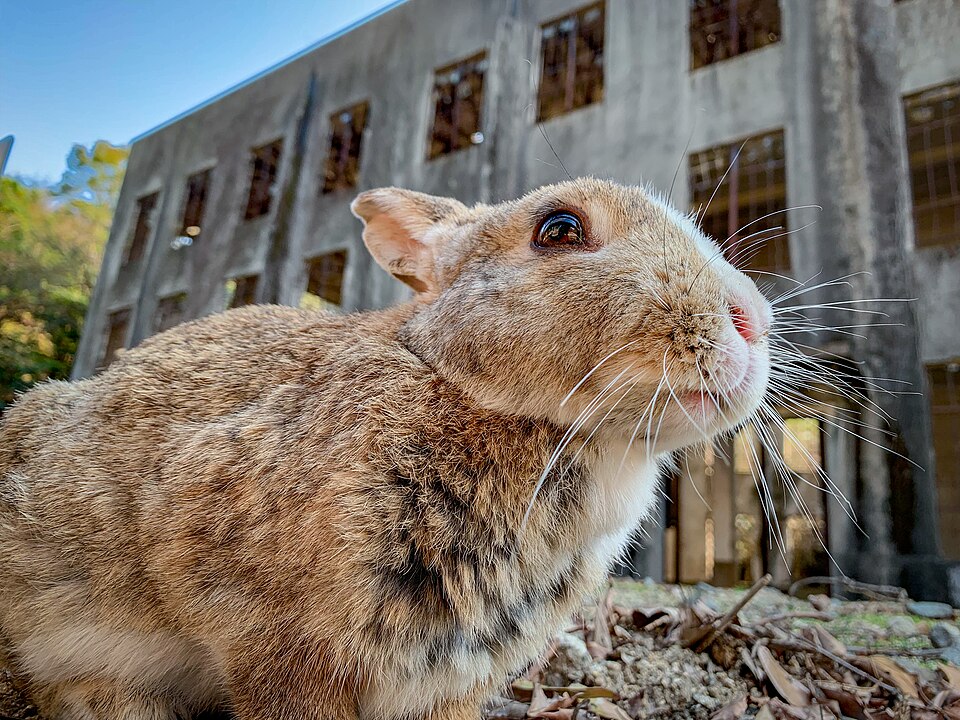
You will not see the factory from the pier. What you see when the ferry docks is rabbits, dozens of them, sitting on the concrete and in the grass with the flat patience of animals who know a boat means food. A short walk up the road, the first ruin appears in the trees: a red brick shell with its roof gone and its window openings framing sky. The rabbits use it for shade.
The factory, 1929 to 1945
The Imperial Japanese Army chose Okunoshima for a chemical weapons plant because the island was small, isolated, and out of sight from the mainland's larger towns. Construction started in the late 1920s and production began in 1929 under the Tadanoumi branch of the Army's arsenal system. By the war's end the plant had produced more than 6,000 tons of chemical agents. One national accounting puts Japan's total wartime output at 7,376 tons, with 90 percent of it made on this island. The products included mustard gas, lewisite, and sneezing and tear agents, and much of the stock was shipped for use in China.
Japan had signed the 1925 Geneva Protocol against chemical weapons. It did not ratify the protocol until 1970, and the factory ran for its entire life inside that gap.
The workforce was drawn from the fishing and farming towns across the water, and late in the war it included mobilized students. Protective equipment was inadequate and the health effects lasted for decades: chronic bronchitis, lung damage, and cancers that survivors and their doctors documented long after the factory closed. Occupation forces dismantled the plant after 1945. Agents were burned, dumped at sea, and buried, and traces have surfaced on the island in the years since.
What "erased" means
The phrase gets used loosely, so here is the literal version. The island was left off official maps produced after 1929. Workers were told not to speak about what they made. Passengers on the Tadanoumi ferry crossed to an island that, on paper, was not there. The Takehara city tourism office now says this plainly in its own English material, which is one of the odd features of the place: the local government publishes a ruin by ruin guide to a secret that its predecessors spent 16 years keeping.
Nothing about the erasure is folklore. The documentation is in the museum and in the tourism office's own literature, and the map itself is the artifact.
The ruins, in the order you meet them
Okunoshima's loop road takes about an hour to walk at a steady pace, or an hour and a half at the pace the rabbits impose. Bicycles rent from the Kyukamura hotel by the 2 hour block or the day. Walking clockwise from the pier, the visible evidence goes like this.
- The Poison Gas Museum, opened in 1988 near the pier, with survivor testimony, equipment, and photographs. It closed on June 22, 2026, after a power failure and reopened on August 8, 2026, according to Takehara City. It is open 9am to 4pm, with last entry at 3:40pm, and adult admission is 150 yen.
- The cenotaph for the factory's workers and victims, a short walk from the museum.
- The laboratory ruins, where agents were tested, now a brick shell behind a fence.
- The power plant, the largest ruin on the island, a multi story shell that supplied the factory and is fenced off. It is the building that appears in most photographs of the island. The interior is marked no entry.
- The storehouse ruins on the northern shore, where finished agents were held before shipment.
- The gun batteries, which predate the factory. They were built after 1902 to defend the Inland Sea and were the reason the Army already owned the island when it needed somewhere for a chemical plant.
- The shelters and the small shrine that the workers used, both inland from the loop road.
Several of these are marked with no entry signs, and the fences are not decorative. The power plant and storehouse interiors are unstable.
Documented versus legendary
The rabbits carry their own legend, and it is the one visitors repeat most. The story goes that the factory's test rabbits were released at the end of the war and that today's colony descends from them. The documented version is different. Occupation forces destroyed the laboratory animals along with the plant. The account that Takehara's own guides give is that a group of schoolchildren released a small number of rabbits on the island in 1971, and the colony grew from those.
What is documented, and less charming, is how the colony has lived since. The rabbits eat what visitors bring far more than what the island grows. Their numbers rose with tourist arrivals before the pandemic, fell when the ferries emptied, and have been unstable since. A study published in the Journal of Ecotourism in July 2026, reported by Phys.org, used camera traps to show wild boars, which swam to the island, hunting and killing rabbits rather than only scavenging them, drawn by the same piles of food. Since 2024, a committee run by the Ministry of the Environment and the local tourism board has asked visitors to stay while rabbits eat what they put down and to carry away anything left. In January 2025, more than 70 rabbits were found dead over a short period and a visitor was detained for kicking one.
Legacy today
The museum's existence is the main thing survivors won. It was built at the end of the 1980s after former workers and local historians pushed for a record of what had happened here, at a time when the factory was barely mentioned in Japan. Across the water, the island's chemical legacy is not finished: Japan's program to recover and destroy the weapons it abandoned in China is ongoing, and the Chinese government still cites Okunoshima by name.
On the island itself the two stories run side by side without touching. Kyukamura, the only hotel, sells rabbit food and rents bicycles. The tourism office's English map labels the batteries and the power plant on the same sheet as the beach. Where I looked for a point at which the rabbit tourism and the war heritage were made to confront each other, there was none: the cenotaph stands a few minutes from the pier, and most visitors walk past it on the way to the rabbits.
Connection to place
The circuit is simple. From Hiroshima, trains reach JR Tadanoumi station, and the port is a short walk. Ferries to the island run roughly every half hour from early morning until evening, and the crossing takes about 15 minutes. Boats also run from Omishima on the Shimanami cycling route. Adult fares were a few hundred yen one way in September 2026.
- Allow 3 to 4 hours on the island: the loop road, the ruins, the cenotaph, and about 45 minutes in the museum.
- Bring water and anything you plan to eat. The hotel is the only place selling either.
- The ruins are for looking at from the road. Fenced interiors are unstable and marked no entry.
- If you feed the rabbits, the committee's guidance is to use vegetables rather than bread or snacks, to wait while they eat, and to pick up what they leave. Chasing or picking them up is discouraged, and pets are not allowed on the island.
- The last ferry back leaves in the early evening. Missing it means a night at Kyukamura or none at all.
The Army's cartographers drew the sea where the island stood. Almost a century later the tourism office prints a map with every ruin numbered, and hands it out at the pier.
Featured Places
Comments
0 on the record
- No comments yet. Be the first witness.