Colares / Operação Prato
In 1977, the Brazilian Air Force sent intelligence officers to Colares island, where residents blamed a light they called the chupa-chupa for burns and a lasting weakness. The records, which Brazil's National Archives began receiving in 2008, document the investigation but do not establish what the lights were or what caused the injuries.
Field Guide Entry
Starting in mid-1977, residents across the fishing communities of Colares island, on the Amazon delta north of Belém, began describing the same strange visitor: a silent light, sometimes disc-shaped, sometimes shaped like a giant flashlight, that appeared over rooftops and riverbanks at night. Locals named it "chupa-chupa," sucker-sucker, after what many said it did to them: hover close, fire a beam, and leave behind burns, punctures, and a lasting weakness. Mayor José Ildone Favacho Soeiro asked the Brazilian Air Force for help, and in September 1977 it opened Operação Prato ("Operation Saucer"), a Brazilian Air Force investigation of reported lights in Pará, documented in military records.
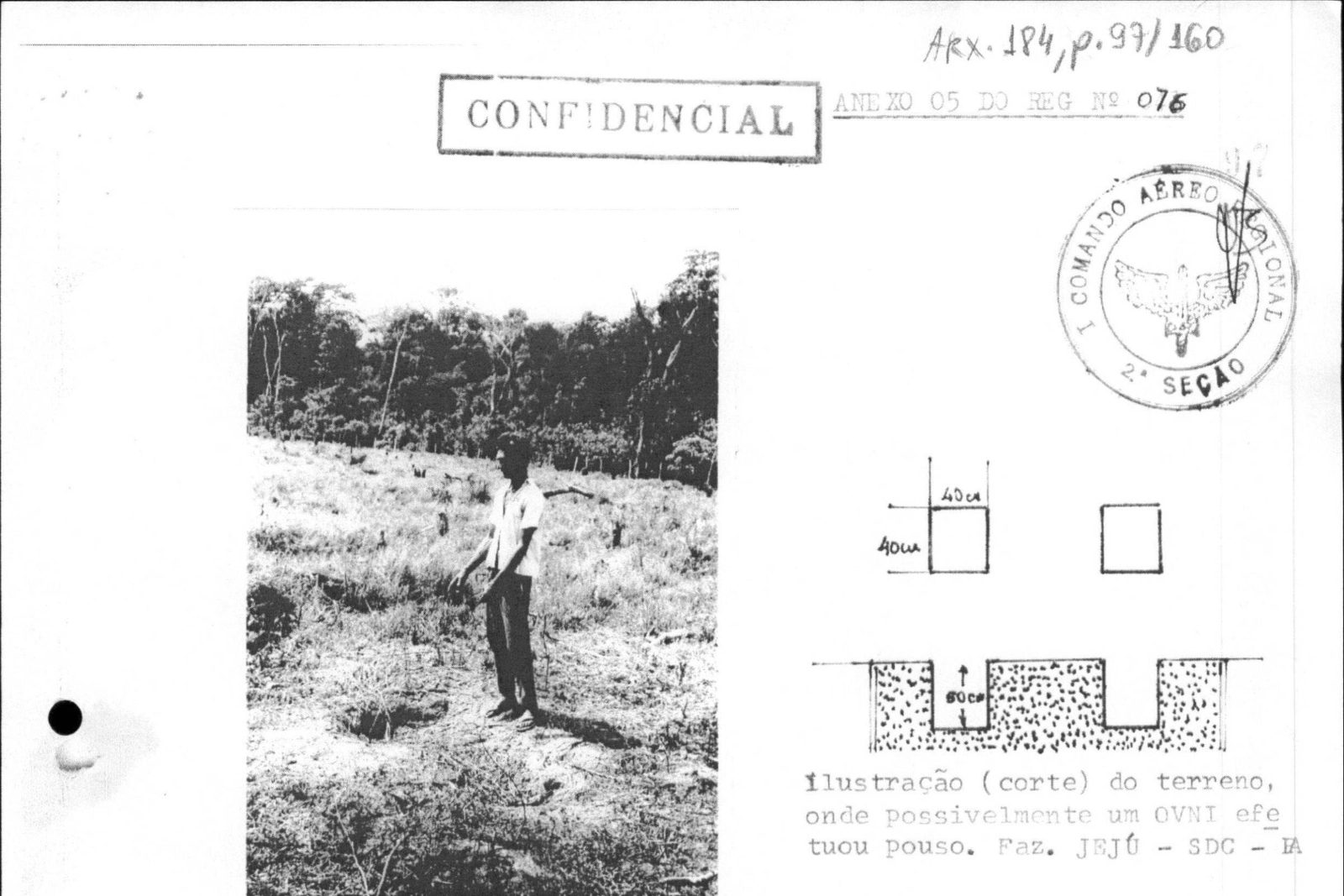
Captain Uyrangê Bolívar Soares Nogueira de Hollanda Lima led a small team of intelligence officers who spent roughly four months in Colares and thirty nearby villages, interviewing hundreds of witnesses and, according to the eventual case file, photographing the lights themselves on several occasions. Local hospitals reported an unusual run of patients with the same complaint: circular burns and reported blood loss with no obvious cause. Brazil's National Archives began receiving Air Force UFO records in 2008. The records include photographs, witness sketches and officer reports. They document an investigation and reported experiences, without establishing the cause of the lights or injuries. Hollanda, by then a colonel, broke a long public silence in August 1997, giving Brazilian ufologists a detailed interview about the operation. He died by suicide two months later, in October 1997, a death his interviewer and friend has attributed to a long-standing depressive illness rather than to anything he revealed, though the timing has kept speculation alive among some researchers regardless.
No chupa-chupa injury was ever independently linked to a specific physical cause, and Brazilian investigators at the time floated possibilities ranging from ball lightning to mass panic amplified by a genuine, unrelated illness moving through the same villages. What is unusual, and rarely disputed, is that a national air force devoted a sustained, multi-month field investigation to the claims rather than dismissing them outright, and that the resulting file was substantial enough to be worth declassifying decades later. Colares today leans fully into the story, marketing itself as "the city of ETs," with alien murals, an "Operação Prato" restaurant, and ET-themed guesthouses lining a town that spent the late 1970s convinced something was hunting it after dark.
Visiting Information
Colares is north of Belém in Pará. The road approach uses BR-316, PA-140 and PA-238 toward the Penhalonga crossing. The municipality describes access by ferry and a bridge construction project. Confirm the current crossing arrangements, bus departures, fares and return service locally before traveling.
Confirm beach access and any visits to local study spaces directly with their hosts. No current opening schedule for a dedicated UFO museum has been verified. Pack repellent and sun protection.
Field Gallery
No approved field photos yet. You could be first.
Community Notes
No community notes yet.

Loring Air Force Base Weapons Storage Area
On the evening of October 27, 1975, by one account, a security policeman guarding the nuclear weapons storage area at Loring Air Force Base watched an aircraft with a red light and a white strobe cross the northern perimeter at about 300 feet. It came back the next night. A memo from the National Military Command Center recorded an unidentified helicopter "landing briefly in proximity to a weapons storage area," and the Air Force never identified it.

Marfa Lights
Local tradition traces the first sighting to rancher Robert Reed Ellison in 1883. Witnesses at the viewing area on U.S. 90 describe small colored lights toward the Chinati Mountains that hover, merge, and split, and skeptical studies attribute many of them to distant car headlights distorted by heat shimmer.

Alleged UFO Skip Site
The Bureau of Land Management built a parking lot and a mile of walking to a patch of public land near Corona it officially calls the place where some people believe a craft came down in July 1947. The ranch where the debris was found is a separate property, private, and closed.

Brown Mountain Lights
In 1922, the U.S. Geological Survey sent George R. Mansfield to Brown Mountain with a surveying telescope. Over about two weeks he took bearings on every light that appeared and plotted them against rail lines, roads, and homesteads. He attributed 47 percent to automobile headlights and 33 percent to locomotives.