Colares, 1977: The Island Brazil's Air Force Was Sent to Watch
Operação Prato was a Brazilian Air Force investigation of reported lights in Pará, documented in military records.
3 hours of light over the water
On the night of December 9, 1977, sometime after 11pm, Captain Uyrangê Hollanda stood at an observation post on an Amazon river island and watched a cylindrical object roughly 100 meters long move low over the water. Amber at first, then bluish. It maneuvered, by his account, for close to 3 hours.
Before we go further, one ground rule, because the entire case depends on it. Hollanda told that story in 1997, twenty years after the fact, and nothing in the file his own operation left behind corroborates it. Everything the colonel says in this article comes with that same asterisk: his word, two decades later, and the paperwork never backs him up. I am going to say that once and trust you to remember it, because the reason Colares matters has never been any single story. It is that a national air force sent an intelligence officer and some twenty men to a river island to investigate the lights, logged what it saw for months, photographed some of it, and left records that are now publicly accessible.
The records are out now. You can read them. That is what this article is about.
| Quick Facts | |
|---|---|
| Location | Colares / Operação Prato, Pará, Brazil |
| Nearest city | Belém; confirm current transport and crossing arrangements |
| Flap dates | Sightings from July 1977; field operation late 1977 into early 1978 |
| The operation | Operação Prato, First Regional Air Command (COMAR I) |
| Archive reference | Arquivo Nacional, Fundo Objeto Voador Não Identificado, BR DFANBSB ARX.0.0.184 |
| Access | Confirm current transport, beach access and any hosted visits before traveling |
What happened, in order
The lights did not start on the island. Through July and August 1977, people around Belém, in Mosqueiro, Ananindeua, and other settlements, described the same visitor: a silent glow, sometimes disc-shaped, sometimes like a giant flashlight, hovering over rooftops and riverbanks at night. Locals named it the chupa-chupa, roughly sucker-sucker, for what many said it did. It would drop low, fire a beam, and leave burns, puncture marks, and a lasting weakness behind.
The reports concentrated on Colares. As they mounted, the town's mayor asked the Air Force for help, and in September 1977 the First Regional Air Command opened Operação Prato, Operation Saucer, under Hollanda's command.
The tidy version of this story says the operation ran four months and closed. The real record is messier, and worth being precise about: some sources say the field operation officially ended in December 1977, others say January 1978, and the documented file spans September 2, 1977, to November 28, 1978, across 15 municipalities in the Pará interior. Whatever the official end date, the Air Force's attention to these lights lasted over a year.
The file, item by item
Most retellings skip the file. It is the best part.
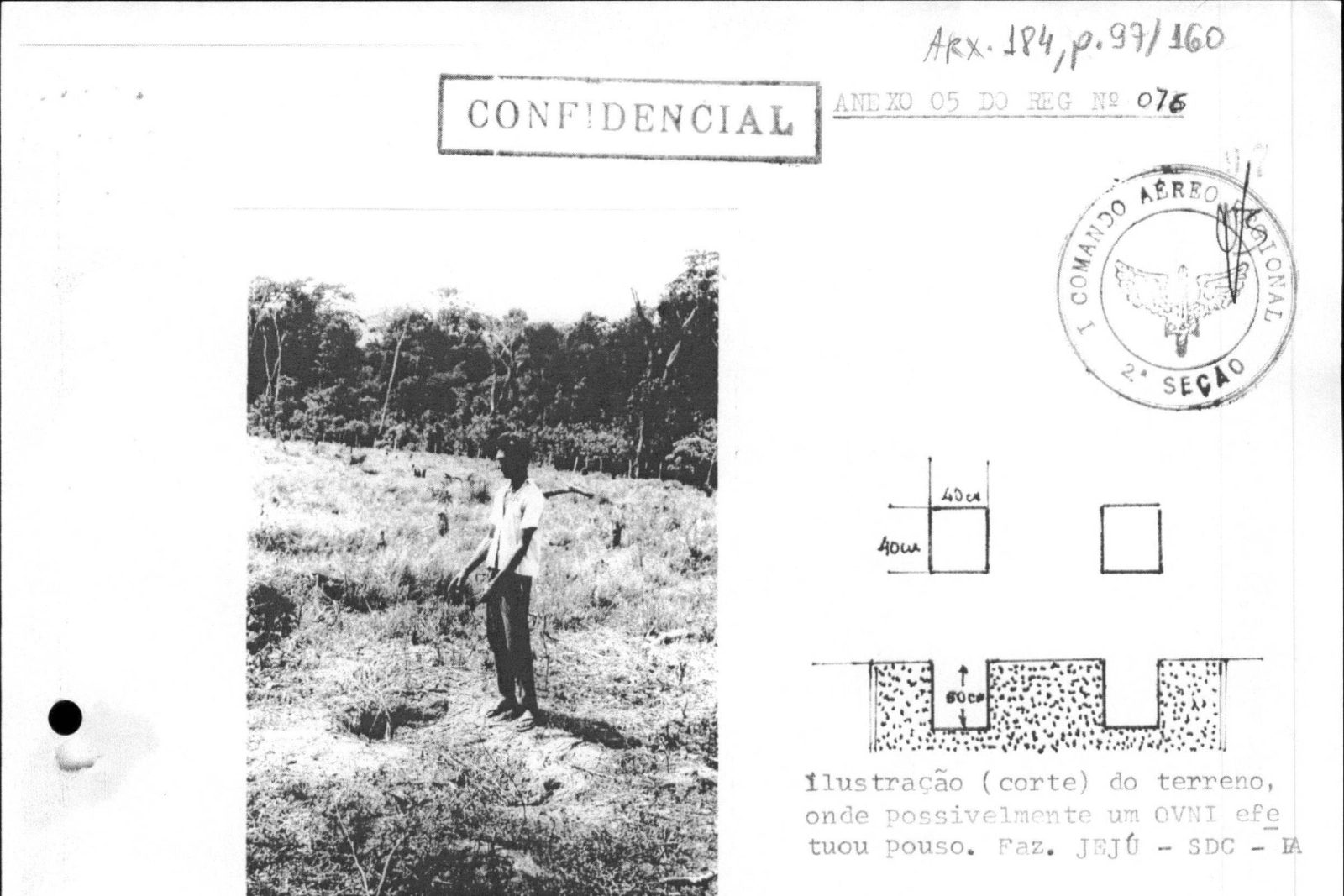
Brazil's National Archives began receiving Air Force UFO records in 2008. Its Fundo Objeto Voador Não Identificado carries the collection code BR DFANBSB ARX. Within it, record BR DFANBSB ARX.0.0.184 documents observations in Pará between September 1977 and November 1978, including Colares.
The Bob Pratt account hosted by The Black Vault describes interviews and reproduces some reports and photographs. It is a MUFON publication, not an inventory of the National Archives collection. It does not establish a total of 126 photographs or the absence of film from the complete operation record. Hollanda's later claims about additional photographs and film remain attributed recollections.
The records document a military investigation. They do not establish what caused the reported lights or injuries.
The doctor who refused
Two people carry this story, and English-language coverage almost always picks the wrong one to lead with.
Wellaide Cecim Carvalho finished her medical degree at 21 and was running the Colares health unit when the flap began. By her own long-form account, she treated around 80 chupa-chupa patients, more than 40 in the first month alone, the pace climbing from one case every three days to three or four a day at the peak.
Her descriptions are the most clinical evidence the case has. Two puncture marks, often on the neck. Burns that necrosed tissue and looked immediately scarred rather than like ordinary thermal or chemical burns, healing over 15 to 30 days and leaving permanent depigmentation. Then there is the detail a physician could measure: sudden severe anemia, hemoglobin roughly halved in the patients she tested, along with muscle weakness, dilated pupils, and reduced reflexes.
She also says Air Force officers pressured her to sedate her patients with Diazepam and tell them they were hallucinating, and threatened her medical license when she pushed back.
"How could I drug an entire population?"
She refused, kept treating, and kept talking about it for the next four decades. Carvalho reported sightings of her own, including a small cylindrical craft with humanoid figures, and locals attributed several deaths in late 1977 to the phenomenon. No autopsy or official record ever connected any death to the lights.
The colonel, and how his story ends
Hollanda broke twenty years of silence in 1997. First on Rede Globo's Fantástico that July, then in August in a long sit-down with Gevaerd and Marco Antônio Petit, published across two issues of Revista UFO. If you watch one thing about this case, make it the full interview with English subtitles, 109 minutes of the commander describing craft at under 100 meters from his posts, the December cylinder, and an incident where a small door opened and a being floated out near his men.
On October 2, 1997, two months after that interview, Hollanda died by suicide at his home in Cabo Frio.
Because a talkative officer died soon after talking, the silencing theory has never gone away, and it deserves a straight answer rather than a raised eyebrow. Gevaerd, who interviewed him and considered him a friend, has said publicly that Hollanda had suffered a years-long depressive illness with a prior attempt, and rejected the assassination reading outright: nobody, in his words, "suicided" him for talking too much. The timing is real, and so is the documented illness. That is where the record ends, and this article ends there with it.
What holds up
The skeptical case is stronger than the mystery-friendly version wants it to be, and the sharpest skepticism comes from inside the operation itself. The military's own reports refer to "the monster created by the press" and describe the region's population, in the blunt language of a 1970s intelligence document, as poor, under-schooled, and easily influenced by media. Injury reports grew after the press coined the chupa-chupa name, which is the shape a feedback loop takes. A contemporary physician, Dr. Zoghbi, argued some wounds were self-inflicted scratching during episodes of hysteria, though Carvalho's clinical record points the other way. The fullest skeptical walkthrough is the Metabunk thread on the case.
While researching this, I went looking for anything that would independently tie one injury to one light, and hit the same wall every researcher hits: there is nothing. No injury conclusively traced, no death medically attributed.
Operação Prato was a Brazilian Air Force investigation of reported lights in Pará, documented in military records. Earlier military investigations are also documented: the U.S. National Archives describes Projects Sign, Grudge and Blue Book, and Brazil's public archive hosts a SIOANI bulletin from 1969. The records establish that military personnel investigated the reports. They do not establish an unexplained cause for the lights or injuries.
Colares, for its part, made peace with the fear. The town now calls itself the Cidade dos ET's, the City of ETs, with alien statues on the corners, an ET-themed Carnival bloco, and a restaurant named Operação Prato serving Amazon dishes under ET-themed names.
Before you go
Colares is north of Belém in Pará. The road approach uses BR-316, PA-140 and PA-238 toward Penhalonga. The municipality describes the ferry crossing and bridge project. Confirm current crossing arrangements, bus departures, fares, return service and local access before traveling. Published schedules and journey estimates should be checked directly with the operator.
Good to Know
- Confirm accommodation availability and booking arrangements directly with the host.
- Praia do Humaitá, a quiet beach a few hundred meters from the center, is where locals place the early sightings.
- This is a working Amazon estuary town: hot, humid, mosquito-heavy. Repellent and sun protection are worth packing.
- Confirm payment arrangements before traveling. Visits to informal study spaces need agreement with the host; no current museum opening schedule has been verified.
- Best window: the Amazon dry season, roughly July through November.
Don't expect a museum with the answers. Colares is a lived-in river town that leaned into its legend, not a curated exhibit. The pleasure is the ferry, the beach, the ET statues, and the strange fact that all of this really did summon a real Air Force operation.
Worth the trip?
If you want a polished attraction with a gift shop and a documentary loop, this is not it. If you want to stand where a documented military UFO investigation took place, eat lunch at a restaurant named after it, and get there by ferry across the Amazon delta, Colares delivers something almost no UFO site can: a place that is ordinary, warm, and lived-in rather than staged. Pair it with a couple of days in Belém and treat the crossing as half the experience.
Four sources worth your time
- The English-subtitled Hollanda interview: the colonel's claims in his own words, and the single most important document of the case that isn't paper. A free English transcript exists if you prefer reading.
- The Arquivo Nacional record description: identifies BR DFANBSB ARX.0.0.184, the record of observations in Pará. The Bob Pratt MUFON account is a separate publication with interviews and reproduced material.
- Dr. Wellaide's interview: the medical spine of the case, in Portuguese and worth machine-translating.
- OperaçãoPrato.com: a Brazilian archive of every TV special on the case, from the 1997 Fantástico segment onward, all in Portuguese.
The ferry, the beach, and the town's easy embrace of its own strangeness are reason enough to go. The file can be read on the bus ride there. What was the Air Force photographing?
Featured Places
Comments
0 on the record
- No comments yet. Be the first witness.