
Single site · Pennsylvania
A Death Row With No Executions
Eastern State Penitentiary in Philadelphia, walked as the evidence for and against the idea it was built to prove.
The route is free. Make the weekend yours.
Add places to stay and eat, parking details, and the full research record.
Table of contents
In 1833, Gustave de Beaumont and Alexis de Tocqueville published their report on American prisons, and two of its sentences state the theory this building was made to test: "Thrown into solitude he reflects. Placed alone, in view of his crime, he learns to hate it." Their appendix records an interview with Prisoner No. 1, the first man sent to Eastern State. He had been inside for more than two years, his health was excellent, and he was making ten pairs of shoes a week.
Charles Dickens spent a day here in 1842, going from cell to cell. His verdict in American Notes: "I believe it, in its effects, to be cruel and wrong."
Eastern State officially abandoned separate confinement in 1913. The practice had been giving way long before that: by the 1870s, half of its prisoners lived with a cellmate. The building kept growing after the idea behind it was gone, from 7 cellblocks to 15. The last of them, Cellblock 15, is known as Death Row, and nobody was ever executed at Eastern State.
The prison closed in 1970 or 1971, depending on which of Eastern State's own sources you read, and daily tours began in 1994. A permanent exhibit on Jewish life inside the prison, Freedom Through Faith, opened on July 2, 2026. The site's first permanent public restrooms are due with a new Welcome Center projected for 2027. Until then, the facilities are a three-stall restroom trailer and two portable toilets.
One ticket, one building, about 2 hours
Eastern State is open every day from 10am to 5pm, March through November. In January and February it opens Wednesday through Monday, 10am to 5pm. From December 1 to 22 it opens Wednesday through Monday, and from December 23 to 31 it opens every day. It closes on New Year's Day, Thanksgiving, Christmas Eve, and Christmas Day, which in 2026 means November 26 and December 24 to 25. The hours page publishes no last entry time.
Adult admission is US$21 online and US$23 at the door. Seniors pay US$19 online and US$21 at the door, and college students and youth aged 7 to 17 pay US$17 online and US$19 at the door. Members and Philadelphia high school students get in free. Holders of Museums for All, ACCESS Card, and SEPTA Key Reduced Fare cards pay US$2 per person for up to four guests, visitors with disabilities pay US$2, and a SEPTA Key Card takes US$2 off an adult ticket bought online. Daytime tickets can be canceled up to 24 hours ahead. These prices are from the visit page, read on September 21, 2026.
Admission includes three kinds of tour. The audio tour, narrated by Steve Buscemi, runs 40 minutes over 10 core stops, with more stops on escapes, sports, sexuality, race, and other subjects. The Guide-Led Tour & Discussion is 45 minutes with an Eastern State educator and is tied to a date and time; it costs the same as online admission, runs at 12pm on weekdays and 11am on weekends with 35 places, and in the ticketing system's own words typically sells out. Mini Tours of 5 to 20 minutes run on topics that change from day to day. There is no guide-led tour on October 3, 2026, the free Firstival day.
Most visitors spend about 2 hours on site. Most of the site is not climate controlled, and Eastern State's own advice is that summers can be quite hot and winters quite chilly. Indoor floors are stone and can be uneven, and outside is concrete, gravel, and grass; sandals and heels are not recommended. The catwalk in Cellblock 7 takes 18 stairs, and restored cells have 8-inch thresholds. Free wheelchairs are lent first come, first served, and there are benches throughout. The accessibility page covers sensory bags, ASL interpretation on request, a monthly ASL guide-led tour, and quiet climate-controlled spaces on request. Service animals are welcome and emotional support animals are not. The daytime visit is not recommended for children under 7.
There are no dining facilities inside the walls and no parking lot of Eastern State's own. Weapons, pepper spray, pocketknives, lighters, flashlights, and alcohol are prohibited. Eastern State's Halloween directions page lists SEPTA bus routes 7, 32, 33, 43, 48, and 49. From October 2 to November 7, 2026, Halloween Nights runs on select evenings under a separate ticket.
The building as it was meant to work
John Haviland won the design competition, and a US$100 prize, with a plan Eastern State describes as "seven cellblocks connected by a central hub like the spokes of a wheel." The legislature had appropriated US$250,000 in 1821, and the prison opened on October 25, 1829. The audio tour counts roughly 300 prisons on five continents modeled on it.
The theory depended on silence. Dickens wrote that a black hood was drawn over the head and face of every prisoner who arrived, and the audio tour reads from warden journals of 1833, 1835, and 1840 recording punishments for breaking silence. Beaumont and Tocqueville compared the system with New York's Auburn model, where prisoners worked together in silence by day, and judged Philadelphia's "more charitable in its whole spirit," though harder to apply.
 A
AThe wall and the gatehouse
The audio tour gives the walls as 30 feet tall, with an additional 10 feet below ground level. The site's own figures for what they enclose do not agree. The audio tour says the completed prison of 1836 covered 10 and a half acres, and Eastern State's 2026 Halloween press release calls it an "11-acre site" in its body and a "10-acre prison site" in its boilerplate.
Eastern State's YouTube channel answered the question most people ask at this gate in a 44-second video in July 2026, titled "Why is there a gothic castle in the middle of Philadelphia?"
 B
BThe central rotunda
Dickens described "a large chamber, from which seven long passages radiate," and wrote of this spot: "Standing at the central point, and looking down these dreary passages, the dull repose and quiet that prevails, is awful."
Cellblock 1, which opened in 1829, runs off the rotunda, and so does Cellblock 7.
 C
CThe first cellblocks
The audio tour gives the cells as roughly 8 by 12 feet, with 20 inches of masonry between them, and names John Currin among the prisoners who wore the hood. Cellblocks 4 to 7 were the two-story additions, which leaves the first three as the original single-story blocks.
Beaumont and Tocqueville's appendix includes a prisoner who told them that during his first months alone he "was often visited by strange visions," among them an eagle perching at the foot of his bed. The audio tour also points out the last surviving open-air exercise yard of the original plan.
 D
DCellblock 7 and Cell 68
Cellblock 7 is one of the two-story additions, with 30-foot barrel-vaulted ceilings.
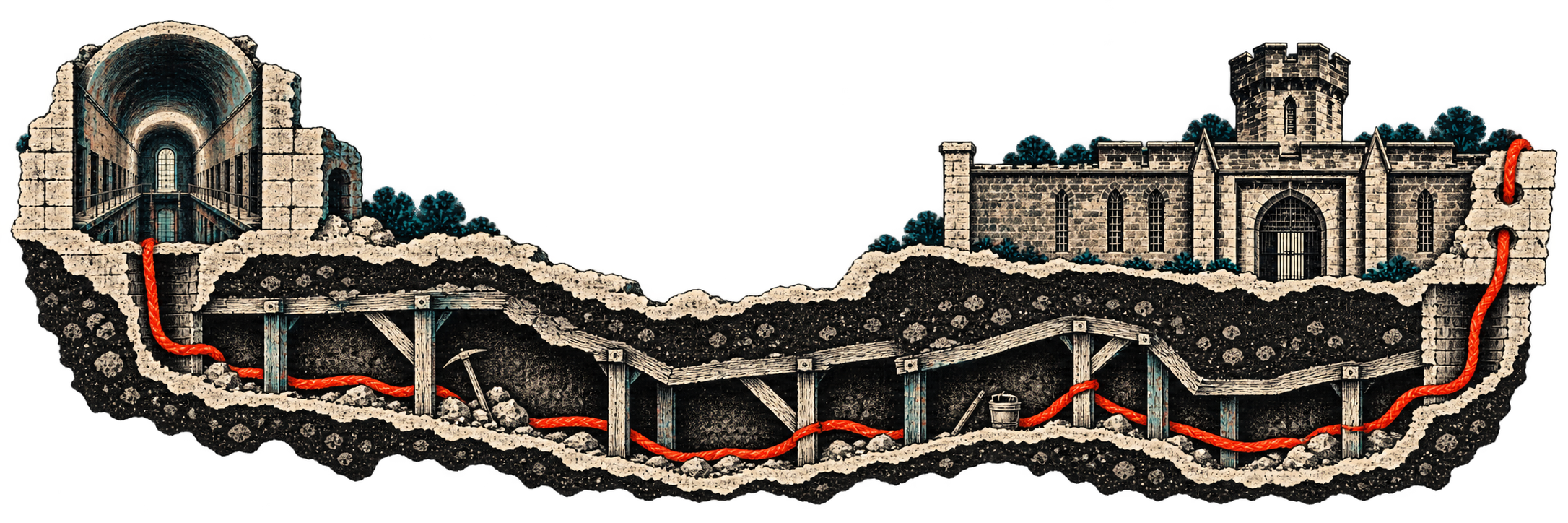
On April 3, 1945, Clarence Klinedinst and his cellmate, William Russell, went out through a tunnel dug from Cell 68, the last cell on the left. The audio tour says the digging took about a year and the tunnel ran "15 feet down, 97 feet out to Fairmount Avenue, and 15 feet up," with lights and wood bracing. Ten more inmates joined them, 12 in all. Willie Sutton was caught within minutes, two blocks from the penitentiary. Klinedinst was caught about 2 hours later and had 3 to 6 years added to his sentence. On April 11, James Grace rang the doorbell and asked to be let back in; the audio tour says he was hungry. All of them were recaptured.
The tunnel entrance was excavated in 2005. A painted line now traces the tunnel's path, and a short archaeology video plays in an open cell. The audio tour counts roughly 100 escapes over the prison's history, and Leo Callahan, who escaped in 1923, is the only one never recaptured.
What the prison became after 1913
A prison designed for 250 men by Eastern State's history page, or 256 by its audio tour, held about 1,700 by the mid-1920s. The last woman held here, Freda Trost, was transferred to Muncy in 1923. The audio tour points out that intake clerks recorded "maroon eyes" and "wooly" hair for Black prisoners whether or not it was true. The largest riot came on January 8, 1961, in Cellblock 9.
 E
EPark Avenue and Al Capone's cell
Capone was arrested in Philadelphia in May 1929 with his bodyguard, Frank Cline, for carrying an unlicensed, loaded .38-caliber revolver, a charge with a maximum sentence of one year. The audio tour says 2 months came off for good behavior, and that instead of being released on the scheduled date of March 17, 1930, he was moved in secret to Graterford and released there. Smithsonian says he served 9 months.
The legend comes from the Philadelphia Public Ledger of August 20, 1929, as quoted by Smithsonian and Mental Floss: "The whole room was suffused in the glow of a desk lamp which stood on a polished desk," with "tasteful paintings" on the walls and a cabinet radio playing a waltz. Capone shared the cell with Bill Coleman, an embezzler, and Warden Herbert Smith said, "Nobody is shown any favoritism, millionaire or pauper." On the audio tour, Sean Kelley says one document has Capone buying his radio from the cell's previous occupant, and gives the museum's conclusion: "We've come to think the truth is somewhere in the middle."
The display is a recreation, and it has moved. In January 2019, conservators uncovered more than 20 paint layers in the original cell, so the staged cell went next door, with plainer furniture, two beds, a shared dresser, and a rag rug. Eastern State describes it as "restored to 1929 appearance." Smithsonian places the original as Cell 1 of the stretch called Park Avenue and the new display in Cell 3, while a 1998 Historic American Buildings Survey photograph captions Capone's cell as "cell block eight, cell one." The two have not been reconciled.
 F
FThe hospital block, Cellblock 3
The audio tour lists what the block held: "operating rooms, recovery rooms, X-ray machines, full pharmacy." Capone had his tonsils removed here in 1929. Cellblock 3 reopened to visitors in 2017, when PhillyVoice reported solarium cells for tuberculosis patients and rooms for hydrotherapy and physiotherapy. The hospital block is one of the rotating Mini Tour topics.
 G
GThe kitchen and Soup Alley
The kitchen is a freestanding building from 1903. The audio tour points out that its porch is a loading dock, and notes an old truck scale. Soup Alley, which Eastern State describes as the prisoner dining area, is one of the current Mini Tour topics.
 H
HThe synagogue and Freedom Through Faith
Freedom Through Faith: Judaism at Eastern State and Beyond, a new permanent exhibit, opened on July 2, 2026, and an opening celebration is set for October 13. The synagogue at its center carries three dates in Eastern State's own material: the 2026 press release and the exhibits page say it was established or opened in 1922, and the audio tour says it was built in 1927. The Torah Ark was built around 1924. Alfred W. Fleisher, whose name the synagogue carries, died in 1928.
Restoration exposed more than 20 layers of paint, and the light fixtures spell out the word shalom. The restored date varies too: the audio tour says the room was returned to its 1960s appearance, the exhibits page says its 1959 appearance, and the press release says it was restored in 2009.
The chapel dates from 1907. A Mini Tour covers the religious murals prisoners painted inside the Catholic Chaplain's Office, and the sources disagree on who painted them. The audio tour names Paul Martin, while a 2026 Summer Nights page credits 23 murals to Lester Smith, painted while he was incarcerated here in the 1950s.
 I
ICellblock 14 and the punishment cells
The audio tour says Cellblock 14 was designed by a Harvard-trained architect who was himself an inmate, serving time for forgery, and built by inmate labor. It is three stories high, with jumper bars, and its cells were designed for two prisoners with no exercise yards. Warden Herbert "Hard Boiled" Smith testified that one-third of the prisoners were "insane, defective or degenerates."
Down a flight of steps beneath the block are four small cells with low ceilings and no plumbing, known as the Hole or, at Eastern State, Klondike. The audio tour says stays ran 10 to 30 days, "sometimes just bread and water."
 J
JDeath Row, Cellblock 15
The audio tour dates Cellblock 15's completion to April 27, 1959, and calls its cells the only modern ones at Eastern State. Eastern State's history page counts 15 cellblocks by 1956. Prisoners here got "no magazines, no books, no visitation" and were "only given one meal a day."
The audio tour explains the name: "Fifteen is often called death row because inmates awaiting execution were housed either here or on One Block. There were never any executions at Eastern State." Condemned prisoners were moved to SCI Rockview to be executed. Elmo Smith, a Cellblock 15 inmate, was executed on April 2, 1962, which the audio tour calls "the last time the electric chair was used in this state."
The Death Row stops also carry Mark Menjivar's DLP Mirror, built from David Lee Powell's death row compositions.
How the ruin became a museum about prisons
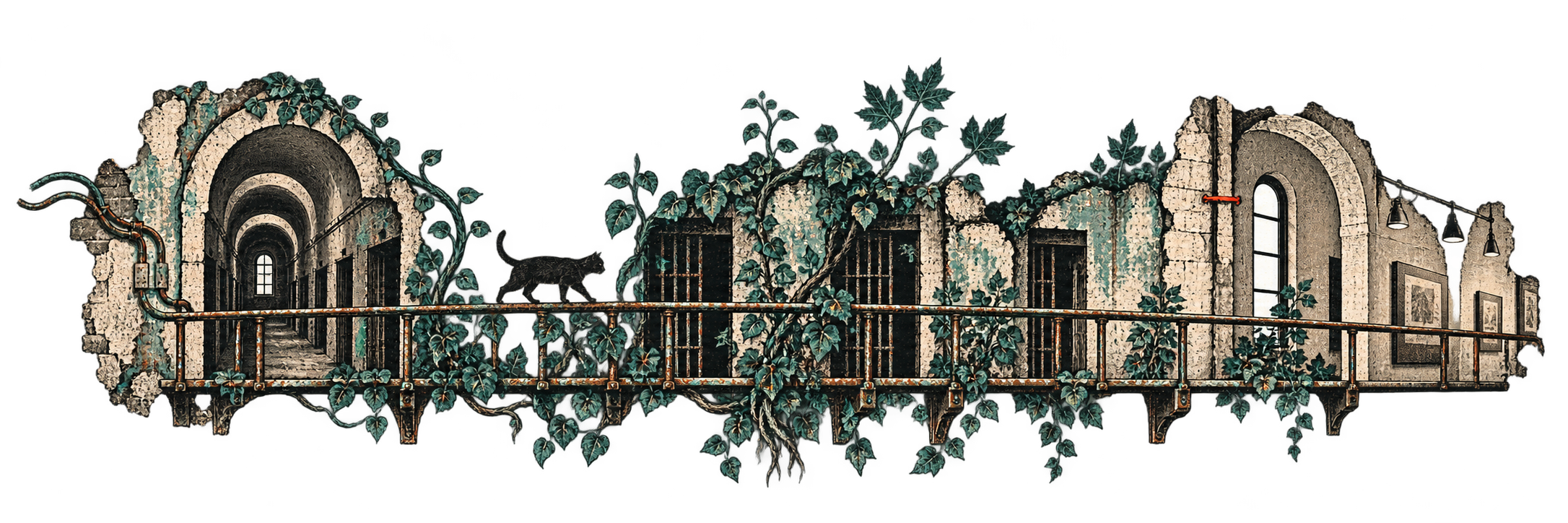
In 1974, Mayor Rizzo floated demolishing the prison for a criminal justice center. The Redevelopment Authority sought commercial reuse in the 1980s, and a 1988 Inquirer piece covered a US$20 million plan to turn the abandoned prison into a shopping center. In the years it stood empty, the site became what Sally Elk, who led Eastern State for nearly 30 years, calls on the audio tour an "urban forest" with a "colony of abandoned cats," and its copper was stripped. In April 1988, the Eastern State Penitentiary Task Force persuaded Mayor Wilson Goode to reject redevelopment. Daily tours opened in 1994, with 10,000 visitors in the first year.
The exhibit Prisons Today: Questions in the Age of Mass Incarceration is part of admission, along with the two stops below.
The baseball field and The Big Graph
The audio tour points out a backstop with goal posts on top and a faint white line that marked foul balls, and says that in the 1960s drugs came over the wall hidden inside balls. The Big Graph stands on the diamond now: a three-dimensional bar graph, scaled to Eastern State's walls, showing incarceration in the United States since 1900, broken down by race.
The art installations
Eastern State lists 14 art installations on view. Among them are William Cromar's GTMO, a recreation of a Camp X-Ray cell; Jesse Krimes's Apokaluptein 16389067:II, 39 panels made from bed sheets; Greg Cowper's Specimen, more than 500 insect specimens inspired by a solitary prisoner's butterfly collection; Tyler Held's Identity Control, a stripped car inside a cell; Solitary Watch's Photo Requests from Solitary; and Cindy Stockton Moore's Other Absences, 50 portraits of murder victims whose killers were held here. Rachel Livedalen's Doris Jean is lettered onto the glass of the greenhouse, which was built around 1936 and used for job training and as a reward for good behavior.
ReVision: Art and Justice, the first show from Eastern State's artist residency, by Cody Stuhltrager, opens on November 20, 2026, and is included with admission.
What the documents say
Pep, prisoner C-2559. A black Labrador arrived in 1924 as a gift from Governor Gifford Pinchot, who had read that Maine's governor gave a dog to that state's prison. The audio tour quotes the letters: Pinchot wrote that it "has motivated me to do the same if it's alright with you," and Warden John Groome replied that he would "very much like to have a dog donated." The date Pep arrived is recorded two ways, August 12, 1924, on the audio tour and August 31, 1924, in the Inquirer and on the archive record for his mugshot. The 2003 audio tour also says his number is skipped in the intake log. The story that he was sentenced for killing a cat is a joke; Eastern State told the Inquirer in 2025 that it has "solid evidence, including letters preserved at the Library of Congress and multiple newspaper articles, that the 'cat murdering' account was a joke." Pep died in 1930.
The iron gag. A committee appointed by the legislature on December 6, 1834, investigated the prison, and Thomas B. McElwee published its proceedings in 1835 as A Concise History of the Eastern Penitentiary of Pennsylvania. The Encyclopedia of Greater Philadelphia dates the death of Mathias Maccumsey under the iron gag to 1833 and describes the device as fitting "over the prisoner's tongue (like the bit of a horse bridle) and attached to his arms pinned behind his back."
When it closed, and who owned it. Eastern State's history page says the state ceased operations in 1970, and so does one stop on the audio tour; three other stops and the Encyclopedia of Greater Philadelphia say 1971. Wikipedia reconciles the two: closed in 1970, with the city briefly housing inmates there again in 1971. The ownership record splits the same way. A University of Pennsylvania history project says the city acquired the prison in 1971 for US$400,000, and Wikipedia says the city bought it in 1980. The prison was designated a National Historic Landmark in 1965.
On film. The audio tour calls 12 Monkeys a 1997 movie. It was released in 1995, with Eastern State standing in for a futuristic mental hospital. The tour dates Return to Paradise, shot mostly in Cellblock 12 in winter with the prison playing a Malaysian jail, to 1999; WHYY dates it to 1998.
Ghosts. Eastern State does not assert them. On the audio tour, Steve Buscemi asks, "Is this place haunted? Who knows?" and answers with what is known: "enormous suffering occurred behind these walls for over 140 years. Men and women died here." He calls the building "certainly 'haunting' if not haunted." A guide told NPR in 2013: "We at Eastern State do not claim that the prison is haunted. We run a haunted attraction." The best-known story, a locksmith's account of Cellblock 4 in the early 1990s, reaches print in NPR's retelling rather than in his own words. The attraction was Terror Behind the Walls from 1997 until 2021, when it became Halloween Nights. The Halloween Nights FAQ adds: "Paranormal investigations (including the use of mediums and EVP recorders or other pieces of paranormal investigation equipment) are not permitted at Eastern State Penitentiary Historic Site."
The load on the body and the load in the exhibits
The physical load is the one Eastern State warns about: uneven stone, the stairs, and heat or cold in a site that is mostly unconditioned. Five indoor areas are climate controlled, including the exhibits and the synagogue, and quiet climate-controlled spaces are available on request.
The heavier material is part of the official interpretation. It includes Death Row, the Hole, Other Absences with its portraits of murder victims, Prisons Today, the race data on The Big Graph, and the audio stops on sexuality, one of which covers a stillbirth after a 1922 rape allegation.
What the rules allow
Personal photography is allowed. A tripod, monopod, or easel needs a photo equipment pass, US$10 for non-members and free for members. Commercial and private photo or film shoots are by application only, at least 2 weeks ahead, and reviewed case by case. Halloween Nights prohibits tripods and drones.
For the building, yes
Yes, if the reason for going is the building. The audio tour and the guide-led tour are both included in admission, and the audio tour's stops run from Haviland's plan to Death Row to The Big Graph. The ghost reputation belongs to the fall festival, which has its own ticket, and the daytime site makes no claim for it. Guide-led tours typically sell out, which makes the timed slot the one thing worth booking ahead.

Complete guide to the trip.
Sign in to purchase
Sign in to purchase
Digital guide · One payment · Yours to keep
Final and non-refundable
- 5 things to see
- 3 things to do
- 3 parking options
- 7 places to eat
- 9 media
- Stops at one address
loading map…
12 stops. Select a pin to see what it is.
Last updated September 22, 2026. Hours, prices, and event details change, and every practical fact above links to the page it came from.
The premium expansion is rechecked every week for readers who own it. Opening times, prices, and event details are read again from the pages linked above, and anything that has moved is updated here.
Official pages
- Plan your visitEastern State Penitentiary Historic Site
Admission prices, what admission includes, prohibited items, and the statements that there is no food or parking lot on site.
- Hours of operationEastern State Penitentiary Historic Site
Seasonal hours and the 2026 closure days.
- AccessibilityEastern State Penitentiary Historic Site
Floors, stairs, thresholds, climate control, and access services.
- Audio tour transcript, stops 1 to 94Eastern State Penitentiary Historic Site
Most building dates and quotes in the stops, including Cellblock 15's completion and the line that no executions took place.
- History of Eastern State PenitentiaryEastern State Penitentiary Historic Site
The radial plan, 15 cellblocks by 1956, the 1913 end of separate confinement, and the 1970 closure date.
- Art installationsEastern State Penitentiary Historic Site
The 14 installations on view.
- Freedom Through Faith, press releaseEastern State Penitentiary Historic Site
The July 2, 2026, opening, and the 1922 date for the synagogue.
- Eastern State Welcome CenterEastern State Penitentiary Historic Site
The 2027 Welcome Center and the site's first permanent public restrooms.
- Fall and winter 2026 programming, press releaseEastern State Penitentiary Historic Site
Halloween Nights dates and the November 20 ReVision opening.
- Halloween Nights FAQEastern State Penitentiary Historic Site
The rule that paranormal investigations are not permitted.
Primary documents
- On the Penitentiary System in the United States (1833)Carey, Lea & Blanchard, Gustave de Beaumont and Alexis de Tocqueville
Beaumont and Tocqueville's report, with the prisoner interviews in its appendix.
- American Notes for General Circulation (1842), chapter VIIProject Gutenberg, Charles Dickens
Dickens on the solitary system, and the Girard College paragraph before it.
- A Concise History of the Eastern Penitentiary of Pennsylvania (1835)The Huntington Library, Thomas B. McElwee
The proceedings of the 1834 legislative investigation.
Reporting and reference
- Eastern State Penitentiary, Encyclopedia of Greater PhiladelphiaEncyclopedia of Greater Philadelphia, Jennifer Lawrence Janofsky
The 1821 appropriation, the iron gag, and the 1971 closure date.
- Al Capone's Philadelphia prison cell, complete with roommate's cot, opens to the publicSmithsonian
The 2019 restaging and the 9-month figure.
- Explore Al Capone's recreated cell at Eastern State PenitentiaryMental Floss
Quotes the 1929 Public Ledger description of the cell.
- Pep the dog and Eastern State PenitentiaryThe Philadelphia Inquirer
Eastern State's evidence that the cat-killing story was a joke.
- Is Eastern State Penitentiary really haunted?NPR
Where the museum's line on ghosts comes from.
- Eastern State to turn Terror Behind the Walls into a kinder Halloween festivalWHYY
The 2021 change to Halloween Nights.
- 7 movies shot inside Philly prisonsWHYY
Release years for 12 Monkeys and Return to Paradise.
- Eastern State Penitentiary's uneasy transformation from prison to museumPhilaMonuments, University of Pennsylvania
The 1971 acquisition figure, the 1988 mall plan, and the task force.
- Eastern State Penitentiary re-opens Cellblock 3PhillyVoice
The hospital block's 2017 reopening.
- Eastern State PenitentiaryWikipedia
Reconciles the 1970 and 1971 closure dates, and gives 1980 for the city's purchase.