
Poveglia Island: The Record Behind Venice's Ghost Island
The real history is stranger than the invented one: a cheese ship, a quarantine, 12 names in a 1793 file, and an island Venetians spent 11 years winning back.

A ship carrying cheese
On June 5, 1793, a small tartana called the San Nicolò came into the Venetian lagoon under an Ottoman flag with 30 men aboard and about 9,000 salted cheeses in the hold. The San Nicolò had sailed from Nauplia, a port in the Peloponnese that Venetian paperwork still called Napoli di Romania. The harbor master sent the ship to anchor in the channel beside Poveglia, and laborers unloaded the cargo the next day. On June 8, the health inspector filed his report: one sailor dead, three more with headaches, black petechiae, and buboes.
Twelve people died over the following weeks. A lawyer named Lorenzo Alugara was commissioned by the Venetian health magistracy to write the episode up, and his manuscript, "Descrizione istorica del contagio sviluppatosi in una tartana," is the reason some of the dead still have names.
That is the plague at Poveglia Island. You will not recognize that story. The version in circulation counts 160,000 plague dead, calls more than half the topsoil human ash, and adds a doctor who performed lobotomies with a hammer before throwing himself off the bell tower. Nobody has produced a document for any of those claims, and none of them appear in print before August 2001, when an American cable show sent a family to spend the night on the island.
| Quick Facts | |
|---|---|
| Where it is | The southern lagoon, between Venice and the Lido |
| What the island was for | Stopping and quarantining ships bound for Venice, from the late 1700s |
| Plague deaths in the records | 12 in the 1793 quarantine, and 20 in total once 1798 is included |
| Plague deaths in the legend | 160,000 |
| The hospital buildings | Rebuilt in 1922, closed in 1968, derelict today |
| Northern half today | Open to the public since August 1, 2025, with no ticket |
| Southern half today | Closed, because the buildings are unsafe |
What Venice wrote down
Poveglia was the last of the city's quarantine stations. The Lazzaretto Vecchio dated to 1423 and the Lazzaretto Nuovo to 1468, and by the late 1700s both were too small for the traffic, so Poveglia was brought in behind them as the Lazzaretto Nuovissimo, the newest one. Ships stopped there before the city let their crews and cargo in. That is the whole of Poveglia's plague career.
Davide Busato, a Venetian historian who has worked through the 1793 file, gives four of the dead by name: Giovanni di Apostoli dalla Spezia, who died within a day; Michiel d'Anagosti, a Greek sailor with a bubo in the groin; Teodoro Sarandachi, also Greek; and Giorgio d'Andriano, Greek, 14 years old.
Two sources drawing on the same Venetian scholarship split those 12 dead in different ways. René Seindal, whose account of the episode is the fullest one in English, writes four sailors and eight local workers. Venetian Stories writes eight sailors and four Venetian laborers. Neither can be checked against the other from the outside, and the disagreement is a fair picture of how much of this record survives.
Alberto Toso Fei, who has spent a career on Venetian legends and knows the difference between one and a document, puts the total across both late-century quarantines, 1793 and 1798, at 20 deaths, with names and surnames on file. The 1798 outbreak was the last appearance of plague in Venetian history.
The state marked the containment the way the Republic marked things. Under Lodovico Manin, its last doge, the mint struck a silver osella showing the Virgin turning an infected ship away from the city, with the legend NEC NUPER DEFECI, "not even now have I failed." The Health Office had spent over 10,000 ducats keeping the outbreak on the island.
The other marker is still there. A block of marble stands in the undergrowth on Poveglia, cut with four lines:
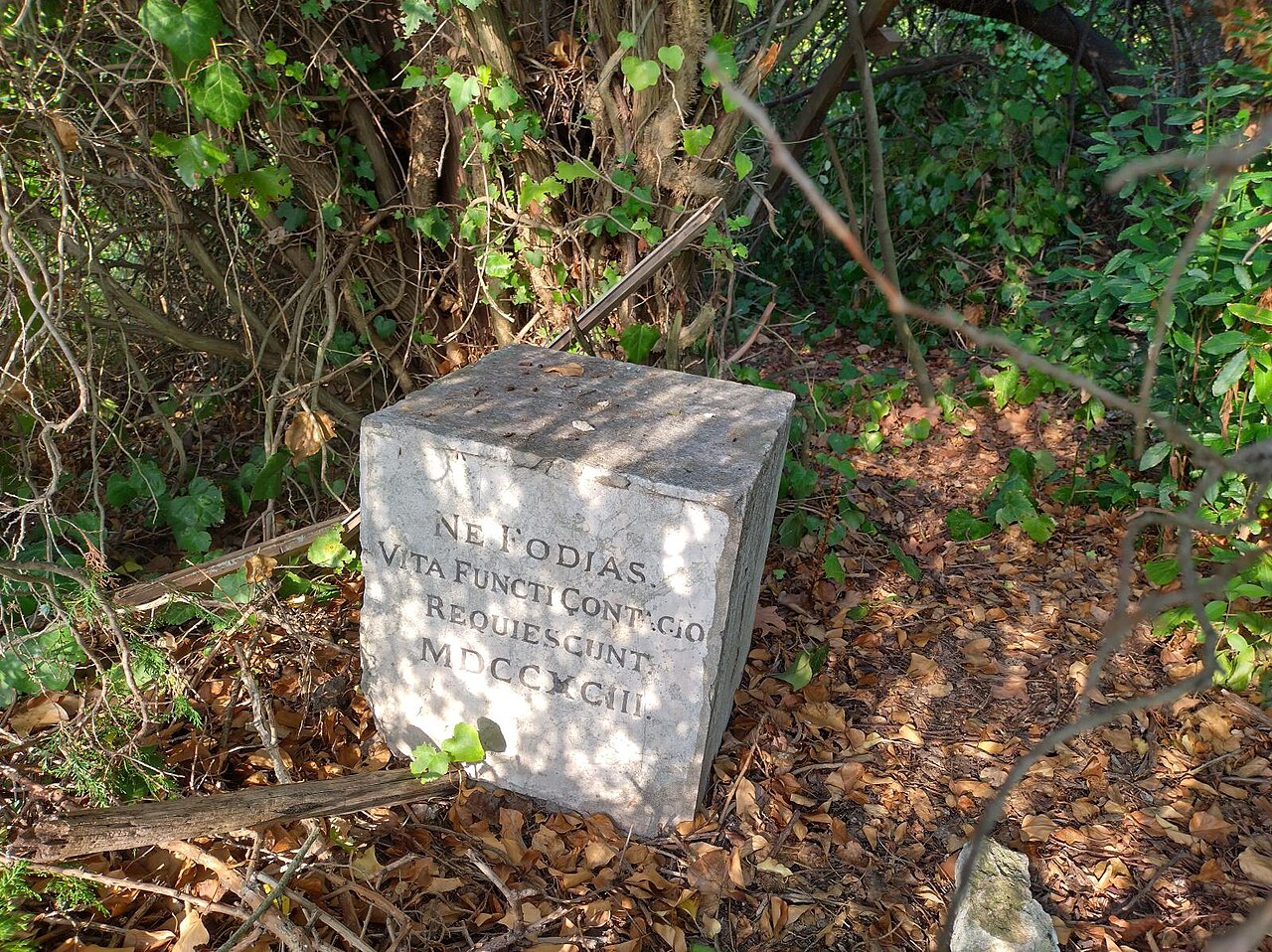
NE FODIAS. VITA FUNCTI CONTAGIO REQUIESCUNT. MDCCXCIII. Do not dig. Those who died of contagion rest here. 1793. The stone names nobody, which was ordinary: poor Venetians went into common ground without individual markers. It was a warning to the living, not a memorial.
Where the ghost story starts
CICAP, the Italian committee that investigates paranormal claims, went looking for Poveglia in Venetian folklore. Its researchers worked through the tradition literature at the Biblioteca Nazionale Marciana and interviewed people who study lagoon storytelling for a living, Toso Fei among them. They found nothing. A city with a large published literature of its own ghost stories has none at all about the island now sold as the most haunted place on earth.
What CICAP found instead was a date. Every paranormal claim about Poveglia the committee could locate postdates a Fox Family Channel broadcast, and the published investigation treats that as the origin rather than the amplification.
The broadcast was Scariest Places on Earth, hosted by Linda Blair and narrated by Zelda Rubinstein. Its format sent ordinary families to spend a night somewhere and filmed them being frightened. Two season 2 episodes came out of Poveglia: "Island of No Return: The Venice Dare" on August 19, 2001, and "The Untold Stories" on August 24. Ghost Adventures arrived in 2009 and carried the material to a far bigger audience, by which point the island already had a script.
The doctor nobody can name
The story is specific in the way invented stories are specific. A doctor at the hospital performed lobotomies with a hammer and chisel. He was driven mad, by what he had done or by what he saw, and threw himself from the bell tower. In some tellings he survived the fall and was walled up inside it. A date of 1930 gets attached now and then.
He is occasionally given a name, and never the same one twice. I found him as Dr. Sareles and as Dr. Paolo, in sources that agree on nothing else about him. No version supplies an inquest, an employment record, a newspaper report, or a relative. Looking for corroboration turns up the same three paragraphs recopied with the adjectives swapped, which is the texture of a story that has no bottom.
The ash claim behaves the same way. The figure in circulation is that more than 50 percent of the island's topsoil is cremated human remains, sometimes with 160,000 bodies attached to it. There is no burial register, no excavation report, and no soil survey behind the number. The sites carrying it cite each other.
The sign on the wall
One piece of the legend has something real underneath it. That piece is the one most retellings skip.
The buildings were rebuilt in 1922 and municipal records describe the new institution as a home for convalescent elderly. The home closed in 1968. But a sign reading reparto psichiatria, psychiatric ward, is still legible on the wall and has been photographed by everyone who has landed there. For years those two facts sat next to each other with nothing joining them.
Toso Fei's answer is that Venice's asylums were on San Servolo and San Clemente, not here, and that the geriatric home on Poveglia contained a psychiatric ward of limited size. He says it in interviews and does not cite a file for it, so take it as his reading. The reading fits the sign, it fits the archive, and it is duller than the version with the hammer, which is why the version with the hammer travels.
The night the fire brigade came out
On July 17, 2016, five Americans in their twenties, from Colorado, paid a water taxi to drop them on Poveglia for a night of ghost hunting. The crew of a sailboat passing in the dark heard screaming from the island and called it in. Venice firefighters took the five off. ANSA ran it the same day.
The association that now runs the northern half of the island keeps an answer to the ghost question in its public FAQ, next to the questions about boats and bins:
These legends are all made up.
What changed in August 2025
In March 2014 the Agenzia del Demanio, the Italian state property agency, put a 99-year concession on Poveglia up for auction with no reserve price and no required project. Patrizia Veclani read the notice in the local paper at a cafe on the Giudecca. Within weeks a group had incorporated as Poveglia per tutti and started a fundraiser under the slogan "99 euros for 99 years." About 4,500 people pledged roughly €460,000 in 40 days.
The association lost. At the May 13, 2014 auction its bid stood at €160,000 against €513,000 from Luigi Brugnaro, whose staffing company Umana wanted the island and who would be elected mayor of Venice the following year. Then the Demanio judged Brugnaro's offer incongruous and refused to sell to anyone. Poveglia stayed where it was, and so did the association, for 11 more years of applications, refusals, and appeals. The regional administrative court ruled for them twice, most recently in November 2024, finding the agency had not given sufficient or logical reasons for saying no.
On August 1, 2025 the northern islet, the half with no buildings on it, passed to Poveglia per tutti on a 6-year concession at about €1,000 a year. Anyone can go. There is no ticket. Sandro Caparelli, one of the founders, has described the whole thing as starting from a question the group asked itself in 2014: if anyone can buy it, why can't we?
NPR's Megan Williams went out with the volunteers in July 2026 and filed the least ghostly dispatch the island has ever generated: people in jeans cutting back brambles on a Sunday morning, planting oak, and mapping the trees. Luca Mamprin, the tree technician running the survey, described the work as "a cartographical job. We need to describe the risk assessment." The plan runs to 2031 and includes a meadow, an arboretum, an aromatic garden, a managed wood, a restored wetland, and a maze cut into the brambles that are already there.
The southern islet, with the hospital block and the bell tower, stays shut. Those buildings are braced and open to the sky in places, and the state still lists that half for future disposal.
Getting to the northern island
Most English-language coverage of Poveglia still says the island cannot be visited. That has been wrong about the northern islet since August 1, 2025. It is still right about everything else.
- No public transport reaches the island. No vaporetto stops there and none is planned.
- Private or rented boat is the standard way in. The association also arranges transport for some of its scheduled events and announces them to its mailing list, so the calendar is worth checking before fixing a date.
- Landing uses a temporary pontoon that the association says does not meet safety standards and wants to replace. A permanent landing reachable from Malamocco, on the Lido, is the priority.
- The southern half is barred by the state property agency on structural grounds. Permits are rare and generally go to research or filming.
- Water taxis from Venice or the Lido will run past the buildings without landing, which is where the familiar photograph of the bell tower comes from.
Good to Know
- There is no water, no electricity, no bar, and no bins. Whatever comes over on the boat goes home on it.
- Fires are not permitted anywhere on the island.
- Nothing on the island is landscaped yet. Long pants and real shoes make more sense than anything else, and the brambles are the reason the masterplan has a maze in it.
- The association takes members and volunteers, and Sunday work parties are how most of the clearing gets done.
- Spring and fall are the comfortable windows. Summer in the southern lagoon is hot, and the cleared ground has little shade.
Four sources worth your time
- The association's own FAQ: what is open, what is not, and the ghost question answered by the people who hold the keys.
- CICAP's investigation: the Marciana search, the missing folklore, and the 2001 broadcast date. Italian, worth machine-translating.
- René Seindal on the 1793 quarantine: the cheese, the crew, and the stone, from someone who has read the Venetian sources.
- Poveglia: Beyond the Myth, a 2019 short documentary about what the island means to the Venetians who use it.
The pier meant to make landing on Poveglia straightforward is currently a sculpture. Lydia Ourahmane built a working pier for 5 Works, her exhibition at the Nicoletta Fiorucci Foundation running alongside this year's Biennale. It sits in the gallery, raised to eye level, waiting on permits. Her curator, Polly Staple, calls it a form of restitution, something left to the island rather than taken from it. If the paperwork clears before the show closes on November 22, 2026, the pier is taken down and shipped out to Poveglia to be used, and what stays behind in the gallery are the eight holes in the floor where it was anchored.
Featured Places
Comments
0 on the record
- No comments yet. Be the first witness.