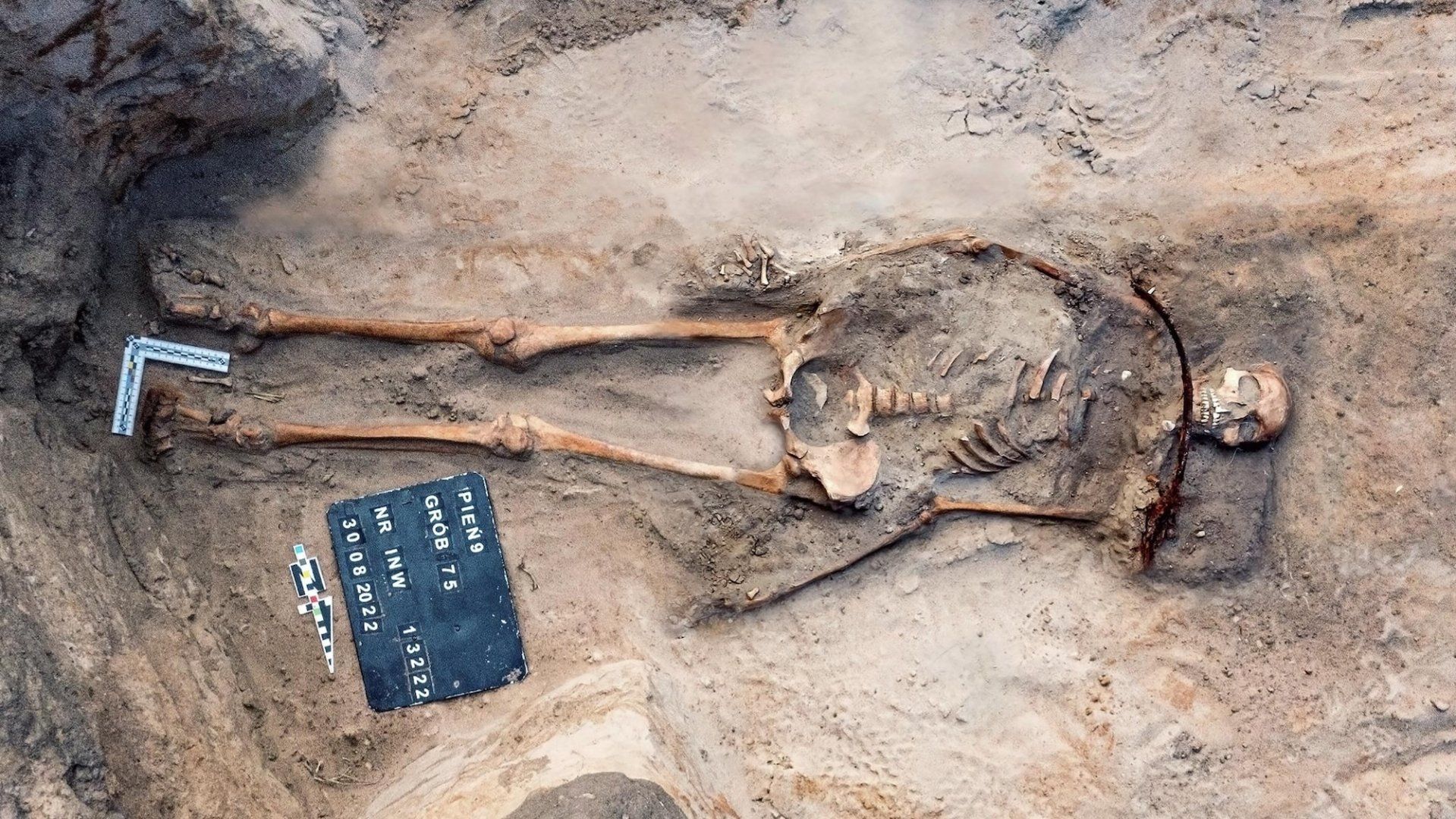
The Vampire Field at Pień
An iron sickle laid across a teenage girl's throat, and a padlock left hanging open on her left big toe: grave 75, opened in a field outside a village near Bydgoszcz in 2022. It is one of 101 burials in a cemetery that appears on no historical map, and the count of graves treated this way runs from a dozen to 30.
Field Guide Entry
Grave 75
On August 30, 2022, a team from the Institute of Archaeology at Nicolaus Copernicus University in Toruń cleared the soil off a burial they numbered 75. A curved iron sickle lay across the woman's throat, blade turned inward, and a triangular iron padlock was fastened around the big toe of her left foot, hanging open. Radiocarbon dating places her death between 1620 and 1674, and she was 17 to 19 years old. The sickle handle was cut from birch, alder, or maple. Analysis published on July 30, 2026, in the Journal of Archaeological Science: Reports described a third measure. The extensive green discoloration associated with copper was observed primarily on the palate, extending into the nasal cavity, the base of the skull, and the first two cervical vertebrae. It was already visible on the day of discovery, immediately after the skull had been cleaned, and the authors rule out a coin as its source. The copper-containing object, or objects, was placed in the mouth, probably in the throat area, shortly after death or immediately before burial. The authors emphasize that this is the first documented burial in which a sickle, a padlock, and traces of an additional object placed in the oral cavity were all used together as measures intended to protect the living against the deceased. DNA placed her maternal line in haplogroup J1c2c1, a lineage with roots in Scandinavia and virtually absent in modern Slavic populations, while isotopes in her childhood teeth say she grew up in or near Pień. The team calls her Zosia.
The rest of the field
Archaeologists have opened 101 graves from the 17th century at Pień, and counts of the unusual ones vary by source, from at least a dozen to at least 30: a burial placed face down, stones deposited in graves (including around the skull), sickles, padlocks, and a child interred in a double grave together with an adult male and arranged in a position resembling a cross. In July 2023, the team opened the grave alongside hers and found a child aged 5 to 7, face down, with a triangular padlock at the foot. The child in grave 92 was identified as a boy through ancient-DNA analysis, as confirmed by lead archaeologist Dariusz Poliński. He has directed the work here since 2005 and has said the cemetery may be the largest of its kind in Poland. It lies on a slope by a crossroads, away from the village and from any church. Previously, during the second half of the 10th and the first half of the 11th century, the area served as an early medieval cemetery with richly furnished chamber graves belonging to members of the local elite who inhabited a nearby stronghold situated above a cut-off bend of the Vistula River. Researchers read the 17th-century layer as Protestant, and as a burial place for people the community would not lie alongside everyone else. What put any one of them there, Zosia included, is recorded nowhere.
What is there now
Until 2025, the parcel was an arable field and was being plowed, and archaeologists spent years asking for it to be protected. On April 23, 2025, the commune of Dąbrowa Chełmińska signed a notarial deed taking it over, transferred at no cost from KOWR, the national agricultural land agency, and an archaeological park at Pień now sits on the commune's list of planned projects. Nothing has been built. There is no sign, no path, and no marker. Local reporting describes stones left on the ground above the place where grave 75 was opened.
Visiting Information
The cemetery field belongs to the commune of Dąbrowa Chełmińska and is not fenced, but nothing has been built on it: no sign, no parking, and no path. It is bare ground between working farmland, so it is best practice to keep to field edges and to leave gates as they were found.
The nearest place with opening hours is the palace and park complex at Ostromecko, ul. Bydgoska 9, a short drive away. From October 1 to April 28, it opens Tuesday through Friday, 11am to 4pm, and weekends, 11am to 5pm. From April 29 to September 30, it opens Tuesday through Friday, 11am to 5pm, and weekends, 11am to 6pm. Admission is 25 zł, 15 zł reduced, and 50 zł for a family, covering both palaces and the park.
Ostromecko gave the Zosia reconstruction its first public showing on November 15, 2025, as a one-off ticketed event rather than a standing exhibit, and no permanent home for it had been announced as of August 2026, so it is worth checking the palace calendar before planning a visit around seeing her. Bydgoszcz is the nearest city with rail and air connections.
Field Gallery
No approved field photos yet. You could be first.
Community Notes
No community notes yet.
Explore More Mysteries

Black Shuck
A black dog reported across East Anglia, and one Sunday morning in 1577 when a storm killed worshippers in two Suffolk churches. A London pamphleteer wrote it up as the devil, and Blythburgh still shows the scorch marks on its door.

Bridgewater Triangle
Roughly 200 square miles of southeastern Massachusetts named as a cluster of strange reports by one cryptozoologist in the late 1970s. The swamp at its center was called the place where spirits dwell long before he got there.

Brocéliande Forest
The enchanted forest of Arthurian romance, identified with the forest of Paimpont in Brittany since the thirteenth century. Its best-known monument is a gilded tree raised in 1991 to mark a fire.

Altar de la Santa Muerte
A life-size Santa Muerte has stood in a glass case on the sidewalk outside Alfarería 12 since Halloween 2001, when Enriqueta Romero moved the figure out of her house and made a private devotion public. The Catholic Church calls the devotion blasphemy and the army has bulldozed shrines in other cities. This one was left alone.