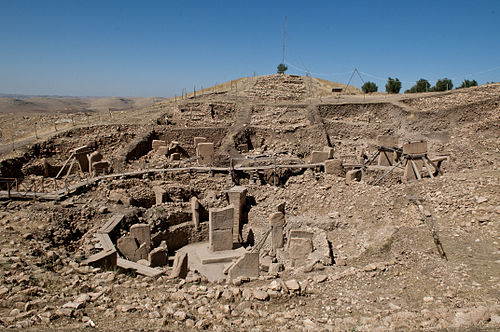
Mount Nemrut
Colossal stone heads ring a man-made mountain summit in southeastern Turkey, built by a king who declared himself a god. Beneath the 50-meter gravel tumulus, his tomb has never been found.
Field Guide Entry
In the first century BC, Antiochus I of Commagene, ruler of a small kingdom wedged between Rome and Persia, ordered a monument to himself on the 2,134-meter summit of Mount Nemrut. Workers built terraces on three sides of the peak and lined them with enthroned statues eight to nine meters tall: Antiochus seated among Greek and Persian gods, flanked by eagles and lions, an artificial pantheon with the king written into it. The summit itself was buried under a cone of fist-sized crushed stone 50 meters high, a man-made peak on top of the natural one. A German engineer, Karl Sester, brought the site to outside attention in 1881, by which time earthquakes had toppled the giant heads to the terraces where most of them still sit.
Inscriptions carved into the thrones (the so-called nomos, Antiochus's sacred law) spell out the king's wish to be buried on the mountain among the gods. Archaeologists have taken him at his word for over a century: the tumulus is widely believed to conceal a royal tomb cut into the rock beneath. Repeated attempts to find it, including excavation campaigns and geophysical surveys from the 1950s onward, have failed. The loose gravel construction defeats tunneling; shafts collapse as fast as they are dug, which many researchers suspect was exactly the point.
There is no serious dispute that Antiochus built the monument or why. The open question is narrower and stranger: whether a burial chamber exists under the tumulus, and if so, whether it survived two thousand years of earthquakes intact. Some archaeologists argue the "tomb" may be symbolic, a cenotaph rather than a burial, with the king's body interred elsewhere in Commagene.
Visiting Information
The site is inside Nemrut Dağı National Park, reached by a steep paved road from Karadut village followed by a 600-meter walk to the terraces. It is open roughly May through October; snow closes the road for the rest of the year. There is an entrance fee, and sunrise and sunset visits (the classic way to see the heads) require separate tickets. Guesthouses in Karadut and hotels in Kahta serve as bases.
Field Gallery
No approved field photos yet. You could be first.
Community Notes
No community notes yet.