Island of the Dolls
A chinampa in the canals of Xochimilco hung with hundreds of weathered dolls by one man over about fifty years. He drowned in 2001 in the same stretch of water where the story he told began.
Field Guide Entry
One man, fifty years
Julián Santana Barrera farmed a chinampa on the Laguna de Tequila, in the canal network south of Mexico City. The account he gave was that he found a girl drowned in the water near his plot, and a doll floating close by, and that he hung the doll in a tree for her. After that he kept going. He pulled dolls out of the canals and the trash, traded produce for them, and hung them across the trees, fences, and the shack he lived in, for roughly five decades.
No record of a drowned girl at that spot has ever been produced. His nephew Anastasio Santana, who now owns the island, has said his uncle told him that sirens were calling him from the water.
April 17, 2001
Santana died that day, aged 80, drowned in the canal beside his own island. His family says he was found in the same stretch of water he had described the girl being found in decades earlier.
The dolls stayed up. They have been rotting in place ever since, which is most of the effect: faces bleached and cracked by sun and damp, limbs missing, eye sockets occupied by insects. Visitors bring more, so the collection grows without anyone curating it. In 2022, Guinness World Records certified it as the largest collection of haunted dolls in the world, which is a category that exists now.
What it has become
The island is a private family business at the end of a long boat ride and it is not the only one. Xochimilco has several doll islands, and the trajinera operators know which is which. Routes advertised as the Isla de las Muñecas frequently stop at a closer imitation, because the real chinampa is a round trip of about 4 hours from the main docks and shorter tours cannot reach it.
Xochimilco itself is a UNESCO World Heritage site, the surviving fragment of the lake-farming system that fed Tenochtitlan.
Visiting Information
Getting to the original island takes a chartered trajinera and roughly 4 hours of round-trip boat time, usually out of Embarcadero Cuemanco rather than the busier central docks. Boats are priced per hour for the whole vessel rather than per person, so the cost splits well across a group and badly alone.
Confirm before paying that the route goes to Isla de las Muñecas itself. Shorter tours routinely stop at a nearer island with dolls on it, and the substitution is common enough that operators expect the question. The family charges a small separate admission on arrival.
Go early. The canals get loud in the afternoon with party boats and mariachi, the light is better in the morning, and the last stretch is open water that can turn choppy. The dolls are somebody's inheritance and the island is somebody's home, so the usual courtesy about photographing people applies to the family as much as anyone.
Field Gallery
No approved field photos yet. You could be first.
Community Notes
No community notes yet.
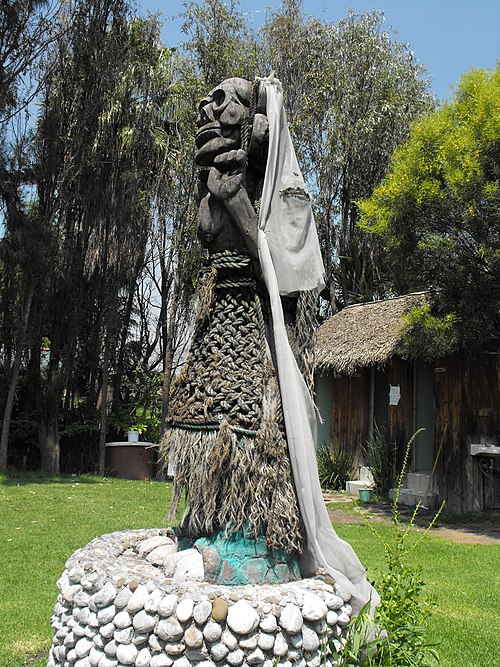
La Llorona
1 miLa Llorona is a weeping woman whose story is told in different forms across Mexico and the American Southwest, including around the canals of Xochimilco. Scholars connect some traditions to Indigenous accounts recorded in the Florentine Codex, but the legend has no single established historical origin.

Mercado de Sonora
11 miMexico City's main public market for traditional medicine and folk religion, a municipal market hall opened in 1957 whose back aisles grew into the country's largest working trade in herbal remedies, Santa Muerte devotion, Santería offerings, and limpias. Roughly two thousand people a week come for that section specifically, and they come to buy and to consult rather than to look.

Templo Mayor
12 miThe main temple of Tenochtitlan, buried under Mexico City for four and a half centuries and found in 1978 when electricity workers laying cable hit a carved monolith over 10 feet across. Excavation has run continuously ever since, and in March 2026 archaeologists announced that six offerings recovered across three different decades had all been buried in a single ceremony.

Templo de San Hipólito
12 miThe largest church in Latin America dedicated to San Judas Tadeo, patron of lost and desperate causes, standing on the ground where Hernán Cortés ordered a monument to the Spanish soldiers killed fleeing Tenochtitlan. Devotees fill Avenida Hidalgo on the 28th of every month, and on October 28 the city closes the surrounding streets.