Sandy Irvine's Camera Is Still Somewhere on Everest
A boot with his name in the sock came out of the Rongbuk Glacier in 2024. The Kodak that could show whether he and Mallory reached the summit has not.

At 12:50pm on June 8, 1924, Noel Odell was standing at about 26,000 feet on the north side of Everest when the cloud lifted. About 800 feet from the summit, he saw George Mallory and Andrew "Sandy" Irvine moving upward. A few days later, he wrote it up in a press dispatch.
"My eyes became fixed on one tiny black spot silhouetted on a small snow-crest beneath a rock-step in the ridge; the black spot moved. Another black spot became apparent and moved up the snow to join the other on the crest. The first then approached the great rock step and shortly emerged at the top; the second did likewise. Then the whole fascinating vision vanished, enveloped in a cloud once more."
Nobody saw either man alive again. If they reached the top that afternoon, they did it 29 years before Tenzing Norgay and Edmund Hillary. The one object that could settle it is a small folding Kodak, and a century later nobody has found it. In September 2024, a National Geographic team found something else, on the Rongbuk Glacier below the north face.
The two men
Irvine was 22, the youngest member of the 1924 British expedition and an Oxford undergraduate with limited climbing experience. He was made oxygen officer, and he took the expedition's oxygen sets apart and rebuilt them lighter and less likely to break. His diary sits in the Sandy Irvine Archive at Merton College, Oxford. His entries from the North Col are mostly about sunburn. On June 3, he wrote of a night "when everything on earth seemed to rub against my face + each time it was touched bits of burnt + dry skin came off which made me nearly scream with pain," then spent the afternoon preparing oxygen apparatus.

Photo: Andrew Irvine at Merton College, unknown photographer, c. 1920, public domain
Odell spotted the pair near a rock step high on the northeast ridge. After they failed to return, he searched Camps IV, V, and VI on June 9 and 10.

Photo: European members of the 1924 Everest expedition, plate from Francis Younghusband, "The Epic of Mount Everest" (1926), public domain
Why the camera matters
Expedition member Howard Somervell lent his Kodak Vest Pocket camera for the summit attempt. The accounts differ on whose pocket it ended up in. National Geographic's October 11, 2024, report says Irvine carried it, and the magazine's follow-up six days later says Somervell lent it to Mallory. Mark Synnott, who searched for Irvine in 2019, calls Irvine the better photographer of the two, and the follow-up adds that Irvine may have carried a camera of his own as well.
The Vest Pocket Kodak was introduced in 1912 and was advertised as the soldier's camera during World War I. Each roll gave eight small negatives, large enough for contact prints. From 1915, the "autographic" models had a small opening in the back that let the photographer scratch a note onto the film's paper backing with a stylus.

Photo: Vest Pocket Kodak Model B, John Nuttall, CC BY 2.0
For the 1999 expedition's website, two Kodak staff, one of them a photographic expert for more than 30 years, set out how the film should be handled if it ever came down: keep it frozen until just before development, cut a small piece from the end of the roll in total darkness to test first, and develop slowly in a reduced-activity developer no warmer than 70 degrees, with no safelight. The 1999 team planned to carry any camera they found, still frozen, to Kodak's labs in Rochester, New York. Their last line was that the answer "may very well be told by a humble, pocket-sized Kodak."
In 2024, Jamie Owen, who manages the Royal Geographical Society's photo collection, was less hopeful. He told National Geographic it "remains so incredibly unlikely that the camera would be found in a state that would actually give us any sort of relevant information," given a century of freezing, thawing, avalanches, and glacier movement.
What the mountain has given back
- 1933: An ice axe turns up on the northeast ridge at about 27,760 feet, identified as Irvine's by the hand-carved nicks he made in his tools.
- 1975: Chinese climber Wang Hongbao leaves his tent at Camp VI for about 20 minutes and finds a body he later describes as an old "English dead." He tells a fellow climber in 1979 and is killed in an avalanche the next day.
- 1999: Conrad Anker finds George Mallory.
- 2024: A boot comes out of the Central Rongbuk Glacier with a sock inside it.
Jochen Hemmleb used Wang's account to plan the search area for the 1999 Mallory and Irvine Research Expedition. The team went looking for Irvine below the ice axe site. The body they found had a name tag that said Mallory.
What was on Mallory, and what was missing
Mallory lay face down, arms outstretched, his hands clenched to the frozen surface. Climber Dave Hahn reported rope around his waist, coming down his legs, and the right leg had an angulated fracture. Snow goggles were in his pocket, which some read as a sign he was descending after dark. The team found no camera.
David Breashears, who had searched for the pair in 1986, said that spring that he would not have expected one: "if I were to be looking for a camera, I would be looking for Sandy Irvine's body."
The 2019 search
Synnott went up the north side in 2019 for National Geographic to look for Irvine and the camera, with photographer Renan Ozturk and expedition leader Jamie McGuinness. Their target was a single crevice. Holzel had picked it out from an aerial photograph made for Bradford Washburn's mapping project, to match an account from Xu Jing, deputy leader of China's 1960 expedition, who said he had seen an old body in a crevice at about 27,200 feet.
Ozturk flew drones from the North Col and shot 400 high-resolution images of the search area. Before the summit push, the expedition's support team objected to leaving the fixed ropes, calling it "too dangerous and against official instructions." On the way down, Synnott unclipped at 27,700 feet anyway and climbed to the GPS point. The crevice turned out to be an optical illusion, a dark vein of rock with a crack 9 inches wide. He wrote: "Far too narrow for a person to crawl inside. And it was empty. He's not here." National Geographic has posted the first full episode of "Lost on Everest," its series on that expedition, on YouTube.
The boot on the glacier
In September 2024, Jimmy Chin was leading a National Geographic documentary team on the Central Rongbuk Glacier, below the north face, with filmmakers and climbers Erich Roepke and Mark Fisher. A few days earlier they had found an oxygen bottle stamped 1933. Then Roepke saw something in the ice. It was an old leather boot, the sole studded with diamond-patterned steel hobnails, and inside it was a foot. "I lifted up the sock," Chin said, "and there's a red label that has A.C. IRVINE stitched into it." Chin thinks the boot melted out about a week before they found it.
When ravens started disturbing the boot, Chin asked the China-Tibet Mountaineering Association, the government body that oversees the north side, for permission to move the remains. He carried the boot down in a cooler and handed it to the association. The team also took a DNA sample and began working with the British Consulate, and members of Irvine's family volunteered their own DNA for comparison. Chin will not say exactly where the boot lay, to keep trophy hunters away, beyond that it was "miles away from where other people were looking."
Julie Summers, Irvine's great-niece and biographer, called the boot "an object that belonged to him and has a bit of him in it" and said she regarded it as "something close to closure." The Royal Geographical Society's position is that any remains should be left in peace, undisturbed, with their position kept private.
The camera theories
A 2022 postscript to Synnott's book "The Third Pole" passed on a story from an unnamed British diplomat: that Chinese climbers had found Irvine in 1975, taken the camera, and buried the body under stones. Summers called it "a desperate attempt to explain why this body could never be found," and said Chin's find "absolutely answered that question." Hemmleb is more cautious and says every theory about Irvine is still valid except, perhaps, one: a Tibetan's claim that Irvine's body was carried down to Lhasa.
The simplest account comes from Anker: "I think that he was swept off the mountain." Summers thinks avalanches carried the remains down and the moving glacier crushed them. Chin is confident more artifacts, maybe even the camera, are nearby, and he calls finding it "the Holy Grail of discoveries." He also describes the glacier: "there are moulins and crevasses everywhere, hundreds of feet deep." A camera that melted out 10 years ago and fell into one, he said, "is going to be gone for another 200 years."
Where it stands in October 2026
The camera is still missing. No report since the 2024 find says it has been recovered.
The remains are believed to be Irvine's on the strength of the name tape, and no DNA result has been published. National Geographic's October 11, 2024, report says only that samples were being compared. Summers and Hemmleb's book "The Everest Mystery" was published by St. Martin's Press on August 25, 2026. Kirkus, reviewing it on May 4, 2026, calls the boot "the first piece of evidence that proved beyond doubt that Sandy Irvine's remains are still on the mountain." Neither Kirkus nor Bookreporter's review of August 28, 2026 mentions a DNA result.
China closed the Tibetan side of Everest to foreign climbers for spring 2026, the Kathmandu Post reported. ExplorersWeb reported in August that there was no sign of a permit for the fall season and that outfitters expected a reopening in spring 2027. The China-Tibet Mountaineering Association is the body that would have to let any search team onto the mountain.
Travelers who only want to see the north side of Everest need a permit arranged through a travel agent in China and an organized tour, according to the UK Foreign Office. On a clear morning, the north face stands at the head of the Rongbuk valley, above the glacier that gave back the boot.
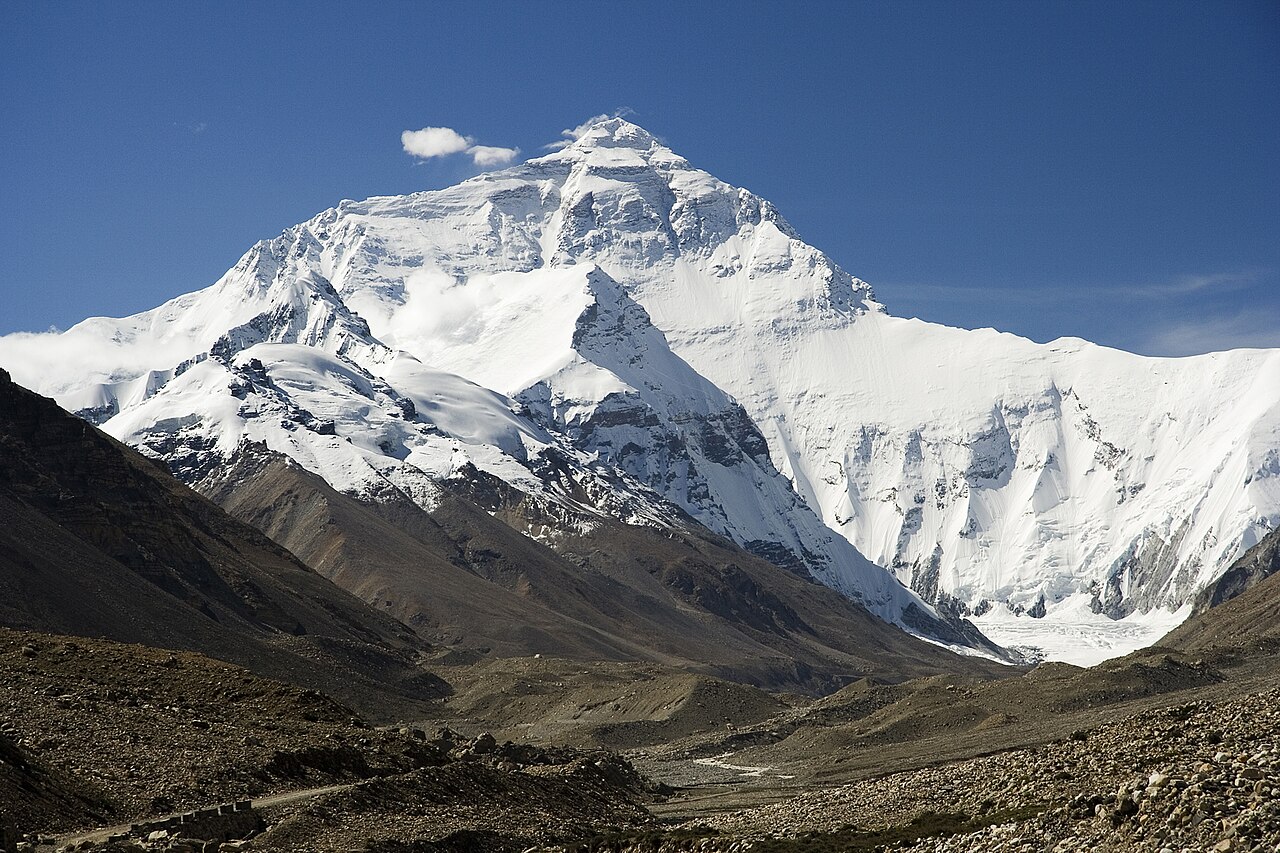
Photo: Everest North Face toward Base Camp, Tibet, Luca Galuzzi, CC BY-SA 2.5
Further reading
- National Geographic's account of the find, October 11, 2024, from the team that made it.
- Mark Synnott's 2019 search, including his visit to Irvine's diary at Merton.
- NOVA's 1999 camera page, with the Kodak staff's instructions for developing the film.
Featured Places
Comments
0 on the record
- No comments yet. Be the first witness.