
Forty Whacks Was Never the Number
The autopsies counted ten and eighteen, the prosecution gave up on the hatchet, and the building that holds the evidence has been closed since 2023.
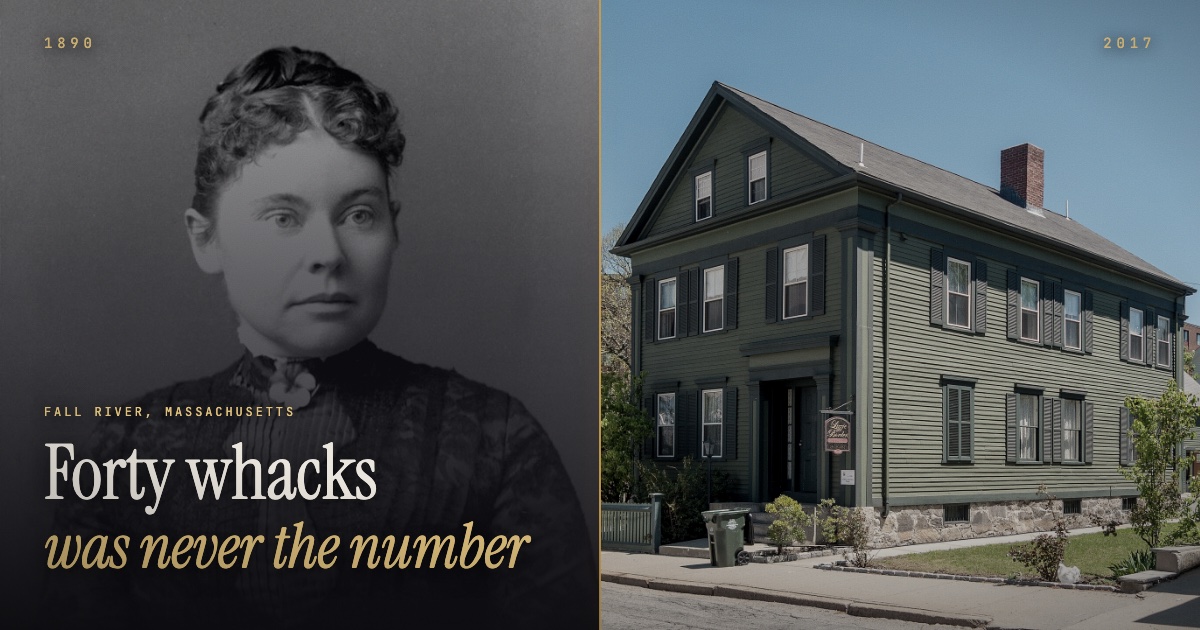
Fall River, this week
On September 17, 2026, Netflix released eight episodes of "Monster: The Lizzie Borden Story." Its own synopsis does not hedge: "Trapped in a cruel Victorian-era household, Lizzie Borden kills her parents in a gory ax murder that shocks the nation."
At 451 Rock Street, the Fall River Historical Society holds the hatchet, the original crime scene photographs, the papers of the two men who prosecuted her, and the papers of the lawyer who defended her. It has been closed to the public since Saturday, July 22, 2023, for an infrastructure project, and says it will reopen in Spring 2027.
The institution holding the evidence published nothing this week. The house where it happened, which holds none of it, ran a watch-along with its tour guides.
One ground rule before we go further, because the whole article depends on it. This is among the most confidently retold murders in American history, and a startling amount of what everyone knows about it is not in the record. The rhyme is wrong about the number. The prosecution gave up on the hatchet. The famous reason her testimony was thrown out is not the reason. I am going to keep pointing at the paperwork, and the paperwork is free.
| Quick Facts | |
|---|---|
| Location | Lizzie Borden House, 230 Second Street, Fall River, Massachusetts |
| Murders | August 4, 1892. Andrew and Abby Borden |
| Verdict | Acquitted June 20, 1893, after roughly 70 to 75 minutes |
| Charged since 1893 | Nobody |
| Evidence | Fall River Historical Society, closed since July 22, 2023 |
| Reopening | Spring 2027 |
What is in the building, and when you can see it
The Society describes its holding plainly. "The Lizzie Borden Collection is without peer in size, range, and caliber." Among the forensic material, by its own listing, are the original crime scene photos, textiles, and the alleged murder weapon.
Here is that collection as an inventory, with the only column that matters on the right.
- The handleless hatchet: closed
- The original crime scene photographs: closed
- The textiles, including the bedroom sham: closed
- The papers of District Attorney Hosea Knowlton: closed
- The papers of Marshal Rufus Hilliard: closed
- The papers of defense counsel Andrew Jennings: closed
- Digitized version available online: none
- Last published admission price: $12
- Date on which that ticket can be bought: none
Research by mail runs $25 to $30 for the first hour, and the fee is kept whether or not anything is found.
The testimony that was suppressed and printed on the same morning
This is the part worth knowing, and almost nothing retells it.
The inquest ran August 9, 10 and 11, 1892, before Judge Josiah Blaisdell. Lizzie Borden answered questions across all three days without a lawyer present. A warrant for her arrest had been drawn on August 8 and was sitting, unserved, in Marshal Hilliard's pocket while she testified.
She was also on morphine. That comes from the prosecution's own witness, Dr. Seabury Bowen, under oath: an eighth of a grain on the Friday, doubled on the Saturday, continued through her arrest and the hearing. On cross-examination he agreed that doubled doses "give people hallucinations." On redirect he walked it back and said the dose she was on would not.
On June 12, 1893, the trial judges withdrew at 11:16am to consider whether the jury could hear any of it. They came back at 12:28pm, one hour and twelve minutes later, and excluded it. No verbatim text of the opinion survives in anything I could reach. The closest contemporary rendering is the Portland Daily Press of June 13, 1893, which has Chief Justice Albert Mason delivering it and gives it, in the paper's own word, in substance: testimony obtained while the accused was under arrest is not admissible, and "the principle involved cannot be evaded by avoiding the form of arrest." The same account has the court finding that Lizzie Borden was within the custody of the City Marshal at the time of the inquest.
Read that against what everyone says about it. The ruling is not about her answers contradicting each other. It is not about the morphine. It is not, as a stated ground, about her lawyer being absent. It is about custody, and the prosecution agreed that was the question. Moody, arguing for the Commonwealth, put it as "the sole question is as to compulsion and arrest." Nobody in that room was arguing about inconsistencies.
Now the part that reads like invention. The stenographer Annie White made exactly two copies of the inquest. Volume one, holding Bridget Sullivan's testimony and all three days of Lizzie's, is lost. Both copies. What survives of Lizzie's words survives because the district attorney lent his copy to the New Bedford Evening Standard, which set it in type in advance as a locked-up supplement, ready to run whichever way the judges went, and printed it verbatim on June 12, 1893.
The same day it was ruled inadmissible, it was on the street.
Every version anyone has read since is a copy of that newspaper. A rival paper ran a corrupted version the same day, which is where three of her most quoted lines come from, including "I do not do things in a hurry." She did not say it.
What the record supports
Going in, I expected the physical case against her to be thin. It is thinner than that.
The blows. The autopsies counted 10 to Andrew and 18 or 19 to Abby. John Henry Wigmore, writing in the American Law Review in 1893, worked from 29 cutting blows across both bodies. The rhyme says 81, and it was not written until after the acquittal. The earliest printings anyone has traced are newspaper filler from February 1894, in Savannah, Indianapolis, an Ohio paper in mid-February, and Charlotte, and the reporting on them says those versions read twenty and twenty-one. I ran the Library of Congress full-text newspaper archive for the rhyme across 1893 to 1895 and turned up nothing from that decade, so those four printings are secondhand here rather than something I put my eyes on.
The weapon. Knowlton, for the prosecution, in his closing: "The Government does not insist that these homicides were committed by this handleless hatchet." Professor Edward Wood found no blood on it, or on any axe or hatchet in the house. The object sealed in the Historical Society as the alleged murder weapon is a thing the prosecution declined to call the weapon.
The blood. This is the case. One pinhead-sized spot on one white skirt. Nothing on her shoes, nothing on her stockings. The prosecution's own chemist told the court "there is no rule at all" about what a killer would be marked with. Wigmore, who thought her probably guilty, wrote the sentence the whole trial turns on: "It is safe to say that this was the decisive fact of the case." He put a parenthesis beside it that is almost never quoted: though it does not appear that her head was examined for blood.
The poisoning. There was none. Wood tested both stomachs and the morning's milk. All negative.
The only suspect. Not true as stated. Edwin Porter, the contemporary reporter who covered it, names roughly ten leads run in the first week. What is true is that each file closed within about a day.
Wigmore, the foremost evidence scholar of the era, thought the court got its exclusions wrong and said so in print the same year: "from the point of view of Supreme Court principles, most of what was excluded seems admissible." You can read him for nothing. See the sources at the end.
Did Netflix get it right
Mostly it did not try to, and its writer has been straightforward about that. Ian Brennan, who wrote all eight episodes: "She was acquitted, but I find it really hard to believe that she didn't do the crime."
What the series gets right is smaller than you would expect and real. Lizzie does not testify, which is correct. The jury deliberates about an hour, which is close to the 70 to 75 minutes on the record. The burned dress, the barn, the morphine and the skulls in court are all in the historical material.
What it invents is most of the rest. The series makes Bridget Sullivan a co-killer who proposes the murders, and gives her and Lizzie a love affair lasting decades. It has Andrew Borden paying Bridget for sex. It has Nance O'Neil coaching Lizzie through the trial, and the two women met around 1904. It completes a poisoning that never happened.
Then there is Bertha Manchester.
The series has Lizzie and Bridget murder her with an axe before the Bordens. Bertha Manchester was killed on May 30, 1893, ten months after the Bordens, while Lizzie was in jail awaiting trial. A man named José Correa de Mello was convicted of it and served 26 years.
Three things I could not confirm first-hand and am not going to assert: whether the series depicts sexual abuse of Lizzie by her father, whether it stages a formal inquest, and what blow count it shows on screen. Every recap and fact-check I read is silent on the first.
The company that runs the murder house published a defense of the series two days before it aired. Lance Zaal, its founder, on the writer:
"His responsibility is not to create historical reenactments or academic documentaries. Ours is."
The company is running a watch-along and hopes to secure a prop from the production for its museum. In 2024 the First Circuit ruled on its trademark suit against a coffee shop next door and noted that its "commercial success... depends in large part on the Lizzie Borden name and lore." The building that holds the evidence cannot speak. The house that holds none of it has a blog.
What you can read tonight, free
This is the part I would do first.
- The 1893 trial transcript and case documents, including the testimony as given.
- Edwin Porter's The Fall River Tragedy, written in 1893 by the reporter who covered it, in full on Project Gutenberg.
- Wigmore's "The Borden Case", American Law Review, November 1893, page 819. I went looking for this expecting a library trip, because it is cited as though it were out of reach. It is sitting on the Internet Archive in full text. The scan's optical character recognition mangles her surname in the running heads, which is probably why nobody finds it.
If you go
The house at 230 Second Street runs as a bed and breakfast and a tour operation. Nothing is priced on its own website, so these came from its live booking system and are what it was selling on September 18, 2026.
- House tour: $30, hourly from 10:30am. The booking engine records 60 minutes and the website says 90.
- Ghost tour: $25
- Ghost hunt: $40, two hours, 10pm nightly
- Oak Grove Cemetery tour: $20
- Overnight basement ghost hunt: $125, 12:15am, eight people
Good to Know
- The Historical Society at 451 Rock Street is shut until Spring 2027. Call 508-679-1071 before planning anything around it.
- Oak Grove Cemetery holds all four Bordens, plus Lizzie's companion Sarah and her friend Alice, in one plot. The Prospect Street gate is open seven days, sun-up to sundown. The city asks for "dignified behavior at all times."
- The house's own FAQ gives the cemetery's hours as 7am to 3pm. Those are the office hours, not the gate hours.
- Fall River and Salem make an unintentional pair, and each is an easy day trip from the other.
This is a real double homicide, not a haunted attraction with a backstory. Andrew and Abby Borden were killed with a hatchet in their own house on a hot Thursday morning. The town has built an economy on it, which is its business. It is worth arriving knowing which parts are evidence and which parts are product.
Four sources worth your time
- Famous Trials: Lizzie Borden: the documents, not the retelling.
- Wigmore, The Borden Case, 1893: the best legal mind of the period, writing months after the verdict, and unconvinced by the court.
- Porter, The Fall River Tragedy, 1893: the contemporary account, free, and the source of the ten dropped leads.
- Fall River Historical Society: closed, but worth watching for the reopening, because the hatchet is in there.
The hatchet the prosecution would not call the weapon is in a building on Rock Street that has been closed since July 22, 2023. The Society says Spring 2027.
Featured Places
Comments
0 on the record
- No comments yet. Be the first witness.