The Government Released Its Bigfoot Files. What's in Them?
A 1982 tracks investigation, a Montana elk hunt, and a 2003 newspaper story, posted to the Forest Service's FOIA reading room.
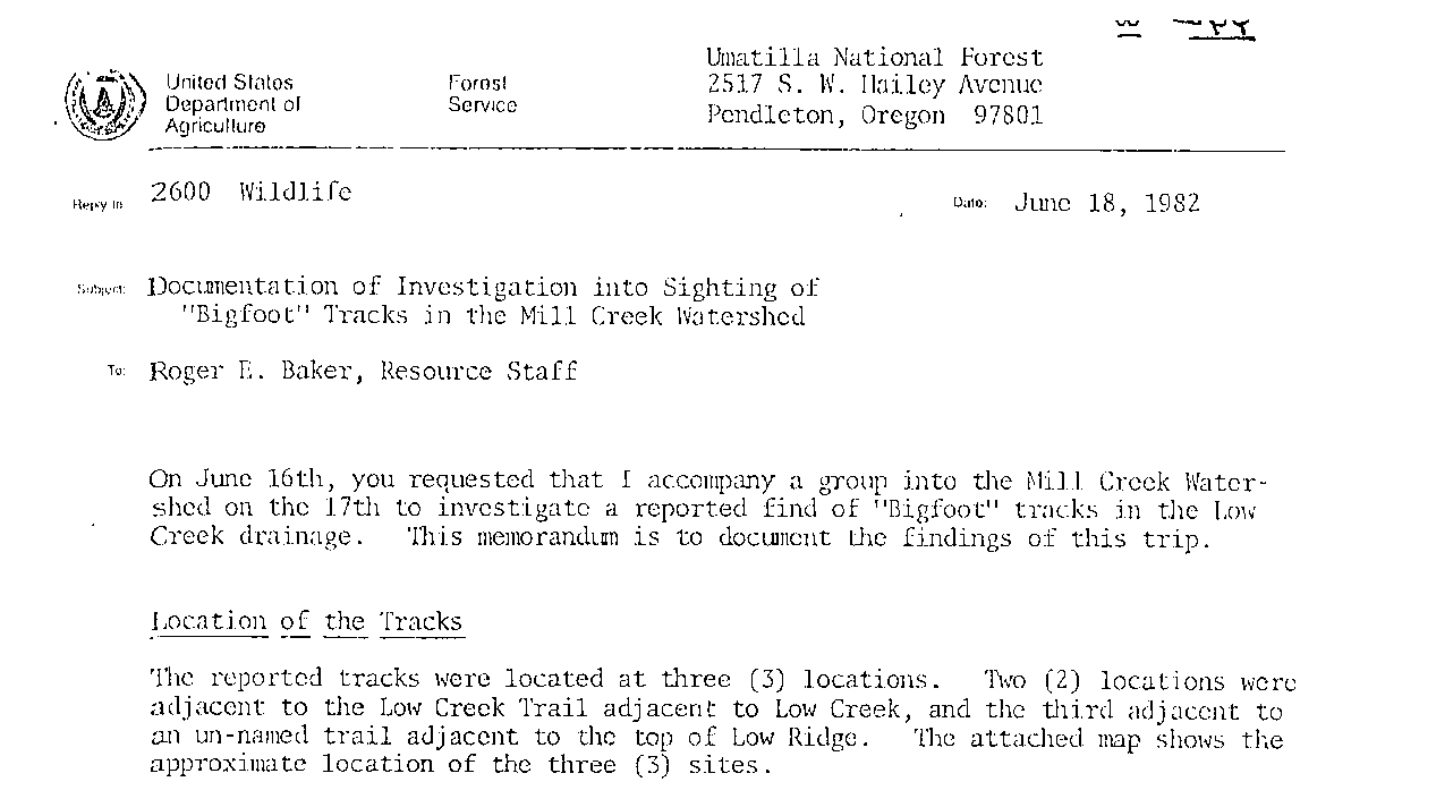
On October 15, 2026, the US Forest Service added an entry called "Bigfoot/Sasquatch Records" to the frequently requested section of its FOIA reading room. It holds three scanned files: a 1982 field investigation from the Umatilla National Forest, a typed local history from western Montana, and a 2003 newspaper clipping. The posting is separate from the Pentagon's UFO releases, which have come out in numbered batches since May. The Freedom of Information Act requires agencies to post released records that have been requested three or more times, or that are likely to be requested again, and the Forest Service has not said what prompted this one.
The Mill Creek tracks
On June 17, 1982, a group walked into the Mill Creek watershed, the 36-square-mile drinking water source that the city of Walla Walla patrols, to look at tracks reported in the Low Creek drainage. The watershed patrolman, Paul Freeman, had reported seeing the animal to the Forest Service that year, according to Matt Crowley's account in Skeptical Inquirer.
The next day, wildlife biologist Rodney L. Johnson wrote up the trip in a six-page memo titled "Documentation of Investigation into Sighting of 'Bigfoot' Tracks in the Mill Creek Watershed." Site A, on the Low Ridge Trail about 1.5 miles above Mill Creek, held 6 tracks over about 25 feet of mud. One right foot measured about 15 inches long and 7 inches wide, and an elk had stepped on its heel during the night. Site B, beside an elk wallow about 2.75 miles up the Low Creek Trail, held about 18 prints over 40 feet. The group cast two tracks at each site and photographed one beside Freeman's boot for scale. A third site, a dry opening with about 12 tracks, was never visited because of the time of day and what the group had concluded at Site B.
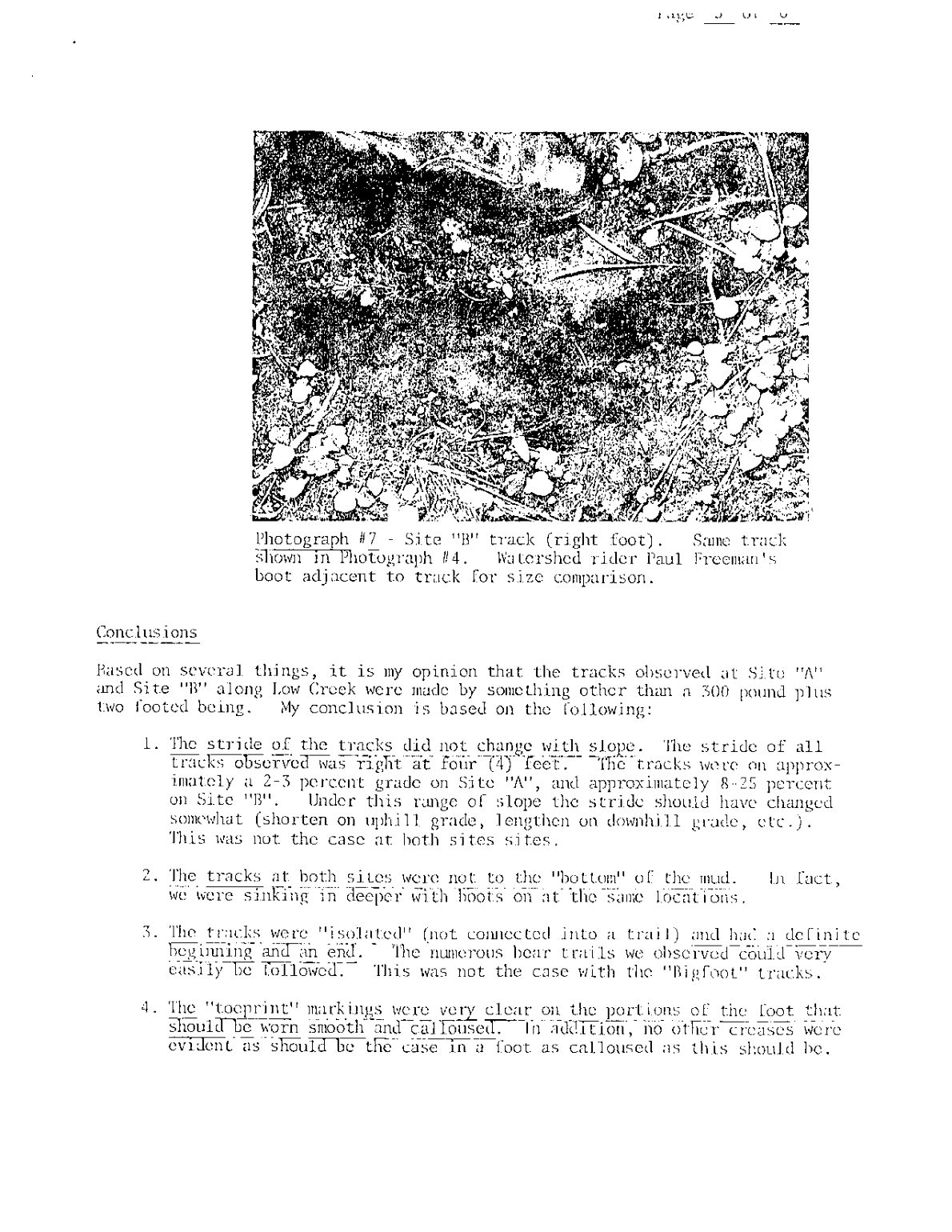
Photo: Rodney L. Johnson memo, June 18, 1982, US Forest Service
Johnson's opinion was that the tracks "were made by something other than a 300 pound plus two footed being." He gave eight reasons. The stride stayed "right at four (4) feet" on a 2 to 3 percent grade and on an 8 to 25 percent grade. The prints did not reach the bottom of the mud, where the men's boots sank deeper. Each set began and ended with no trail leading in or out, while the bear trails nearby "could very easily be followed." At Site B, the forest litter looked as if it had been brushed aside before the print was made. The small toes had no pads at the tips, the heels never slipped on the steep wet ground, and some prints looked as if the foot had been rocked from side to side.
"If the tracks were faked, someone went to a great deal of trouble and detail," Johnson wrote. The print marks on the foot "appear very natural," he wrote, and he "would almost suspect a cast made of an actual foot" had been used to make them. He handed the negatives and the plaster casts to the district.
The tracker's verdict
Joel Hardin, a US Border Patrol tracker from Bellingham, walked the same sites on June 17. On July 28, 1982, he sent his opinion to Wayne Long, the Walla Walla District supervisor: the tracks were "a very clever attempt to perpetrate a hoax, involving your office or agency, in order to lend authenticity or credibility to the general public." Hardin believed they were "man made by using some type of soft plaster or rubber coated foot." They kept an exact stride uphill and downhill, put the same weight on heel and ball either way, and "appeared and disappeared on the trail with no sign leading to or away from the area." His profile of the maker was "someone with normal access to the area, very knowledgeable and interested in 'Bigfoot' legends and stories."
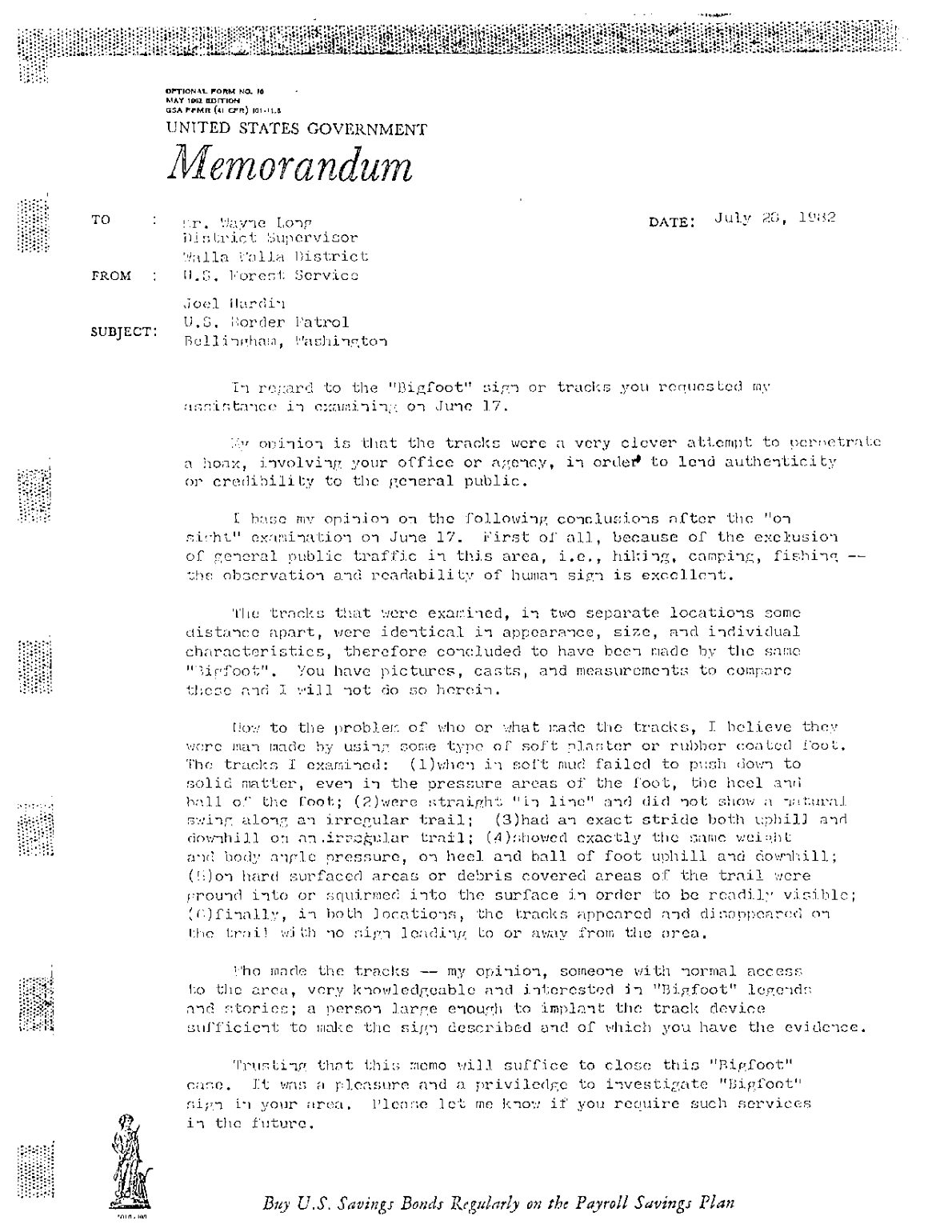
Photo: Joel Hardin memo, July 28, 1982, US Border Patrol
Hardin ended with "Trusting that this memo will suffice to close this 'Bigfoot' case." It did not close. Freeman reported more tracks and sightings into the 1990s, and the anthropologists Grover Krantz and Jeff Meldrum treated his casts as serious evidence, Crowley writes. Crowley also quotes Hardin's book "Tracker," which says Freeman later "admitted to authorities that he had not only made up the story but had constructed some 'feet' to make tracks." Freeman's son published a defense of his father's finds in 2022.
Petty Creek, Montana
The second file is six typed pages called "What Do You Know About Petty Creek? Leo T. Kinney's Version." Petty Creek meets the Clark Fork about 2 miles east of Alberton, some 30 miles west of Missoula. Kinney writes from 1980 and spends most of the six pages on homesteads, the sawmill town of Lothrop, 1,600 Texas longhorns turned loose in the hills, and Army pack camels whose feet froze on the run from Walla Walla to Fort Benton.
Bigfoot gets one paragraph on page 3. Kinney and three others went in to pack out a six-point bull elk and found only the entrails, with "a large set of tracks" in the snow coming and going. Whatever it was "had picked up the elk whole and clear of the ground," Kinney wrote. Half a mile on, the tracks crossed a log 3 feet thick, and the snow on top showed where the horns had dragged. The four decided they "were not particularly anxious to catch up." Nobody saw the animal. The year is typed as 194 with the last digit struck over, in the South Fork of Petty Creek. The next year, W.W. Schmitz found the same kind of tracks near Bills Creek, smelled a strong odor, heard grunting, and hunted somewhere else. "At this time we had never heard of Bigfoot," Kinney wrote.
River Road West, 2003
The third file is the front page of the Clark Fork Valley Press of Plains, Montana, under the headline "Mysterious tracks discovered near River Road West." The paper's page 2 header dates the issue January 15, 2003, and the Forest Service file name gives January 13.
An 8-year-old boy found the prints at about 3pm on January 3, near the sawmill of 87-year-old Jim Rohweder. A neighbor, Bob Mesing, counted hundreds of them in 2 inches of new snow and measured one at 16 1/2 inches long and 8 1/2 inches wide. Dean Petersen guessed from the size of the print that the animal weighed 800 to 1,000 pounds. The tracks came from the direction of Eddy Creek, crossed the Rohweder yard, turned around, and headed for the Clark Fork River before fading under the trees about 100 yards into the woods. Gladys Rohweder said that when the couple first moved there, 30 years earlier, she saw a hairy, two-legged creature.
The men found a large pile of dung, planned to send a sample to a lab, and decided against it. "If someone played a hoax, they did a pretty good job," Mesing said. "I hope no one does explain it because I had fun running around like a chicken with my head cut off." The same story noted that California resident Ray Wallace "faked the famed prints of a 1958 Bigfoot," the Humboldt County tracks that put the name Bigfoot in front of the country.
None of the three files names whoever made the tracks. The Forest Service filed all three under its Watershed, Fish, Wildlife, Air, and Rare Plants business area.
Featured Places
Comments
0 on the record
- No comments yet. Be the first witness.