Denver Airport Conspiracy Landmarks You Can See in Person
A practical field guide to the blue horse, the gargoyles, the murals, and the Masonic capstone at DEN.
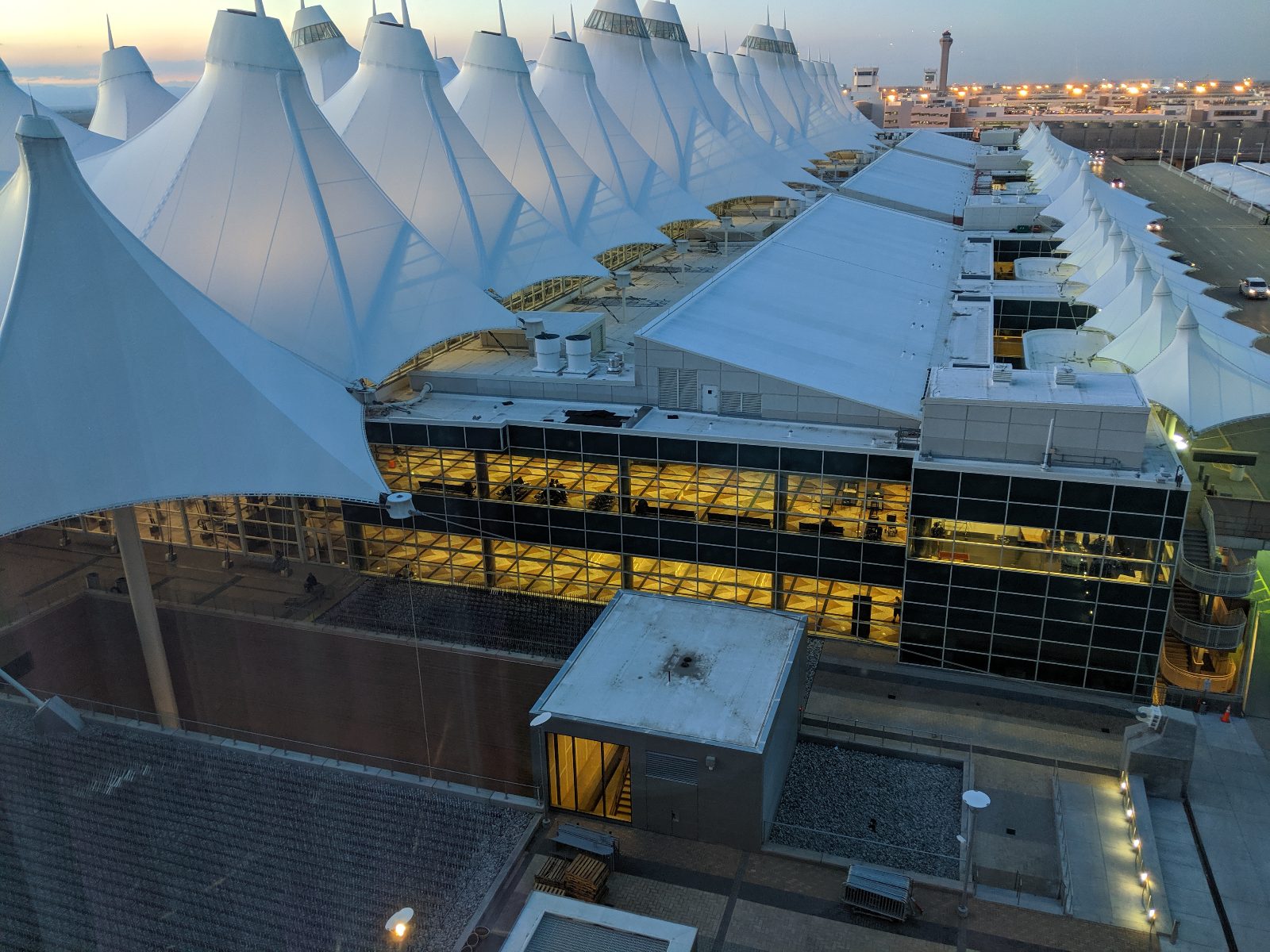
The landmarks behind the theories
Few places in America have picked up as much strange lore as Denver International Airport. Since opening in 1995, DEN has been connected to stories about underground bunkers, Masonic groups, the New World Order, reptilian tunnels, and a giant blue horse.
Most of those stories have been told plenty of times, usually with the same handful of photos. What is harder to find is something much more useful: if you are passing through Denver and want to see the things behind the theories, where do you go?
That question sent us much further down the rabbit hole than expected because these landmarks are scattered around the airport, some are surprisingly easy to walk past, and a few of the directions still circulating online are outdated. One of DEN's most famous conspiracy attractions is not even on display right now.
The interesting part is that most of the objects behind the stories really do exist. The argument is over what they mean, so instead of running through the same theories again, here is what you can look for when you visit.
Stop 1: Blucifer, before you reach the terminal
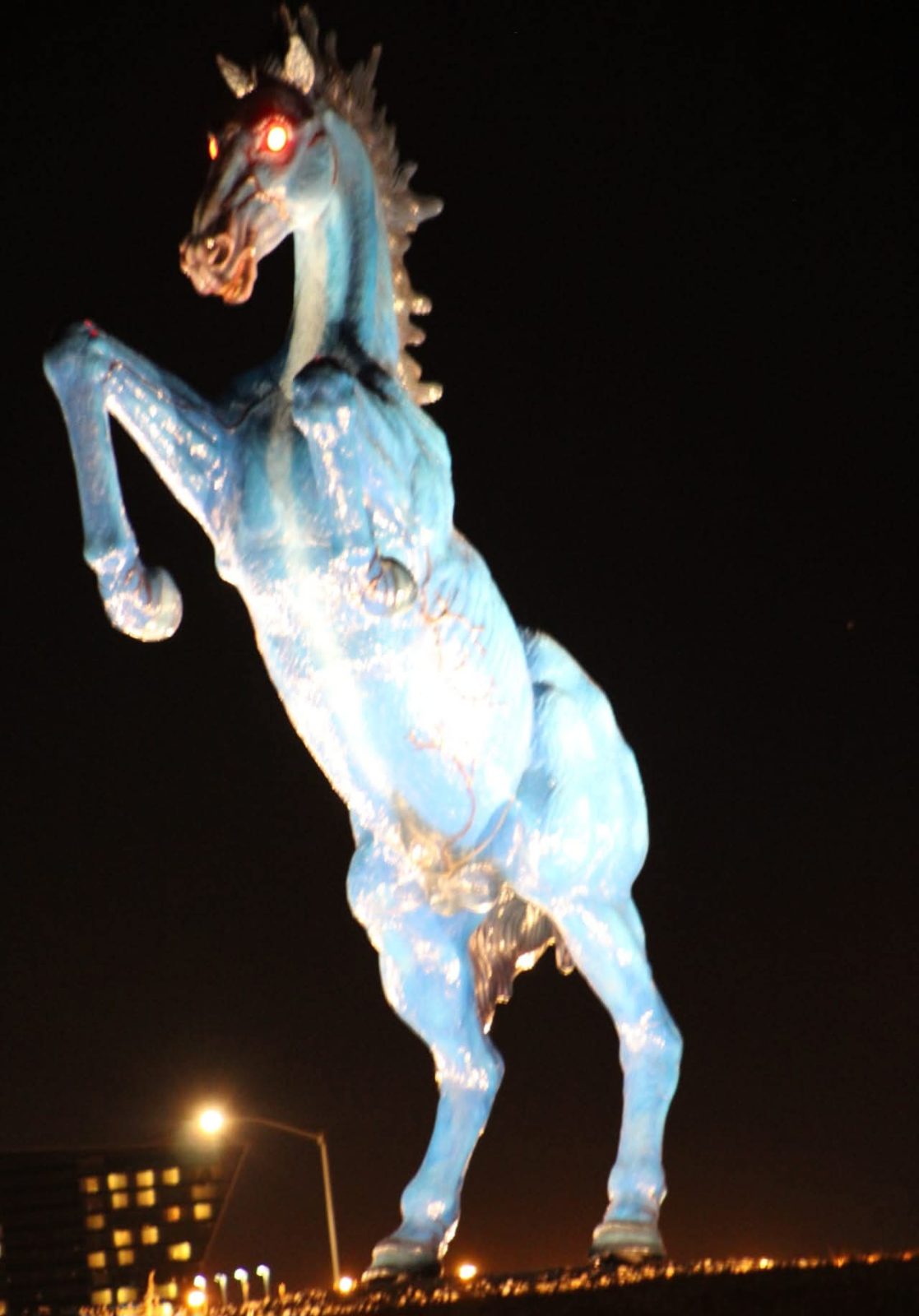
Your first stop comes before you even make it inside. Mustang is a roughly 32-foot fiberglass sculpture of a rearing blue horse by artist Luis Jiménez, installed along Peña Boulevard on the approach to the airport. Almost nobody calls it Mustang anymore, though. Around Denver, it is better known as Blucifer, which makes a little more sense once you see it at night with its glowing red eyes.
It did not take much for the horse to become part of DEN's conspiracy lore. A giant red-eyed blue mustang standing guard over an airport already rumored to have a secret underground complex was always going to attract some stories, but the strangest part of Blucifer's history is not a conspiracy at all. Jiménez died in 2006 while working on the sculpture after a section fell and severed an artery in his leg, giving the finished horse a tragic backstory that did not need any help from the internet.
Good to Know
- Blucifer is along Peña Boulevard, so look for it while approaching or leaving the airport rather than once you are inside.
- Passengers will have a much easier time getting a photo. If you are driving, keep driving.
- The glowing red eyes are much more noticeable after dark, making an evening arrival or departure the better time to see it.
Stop 2: Go underground
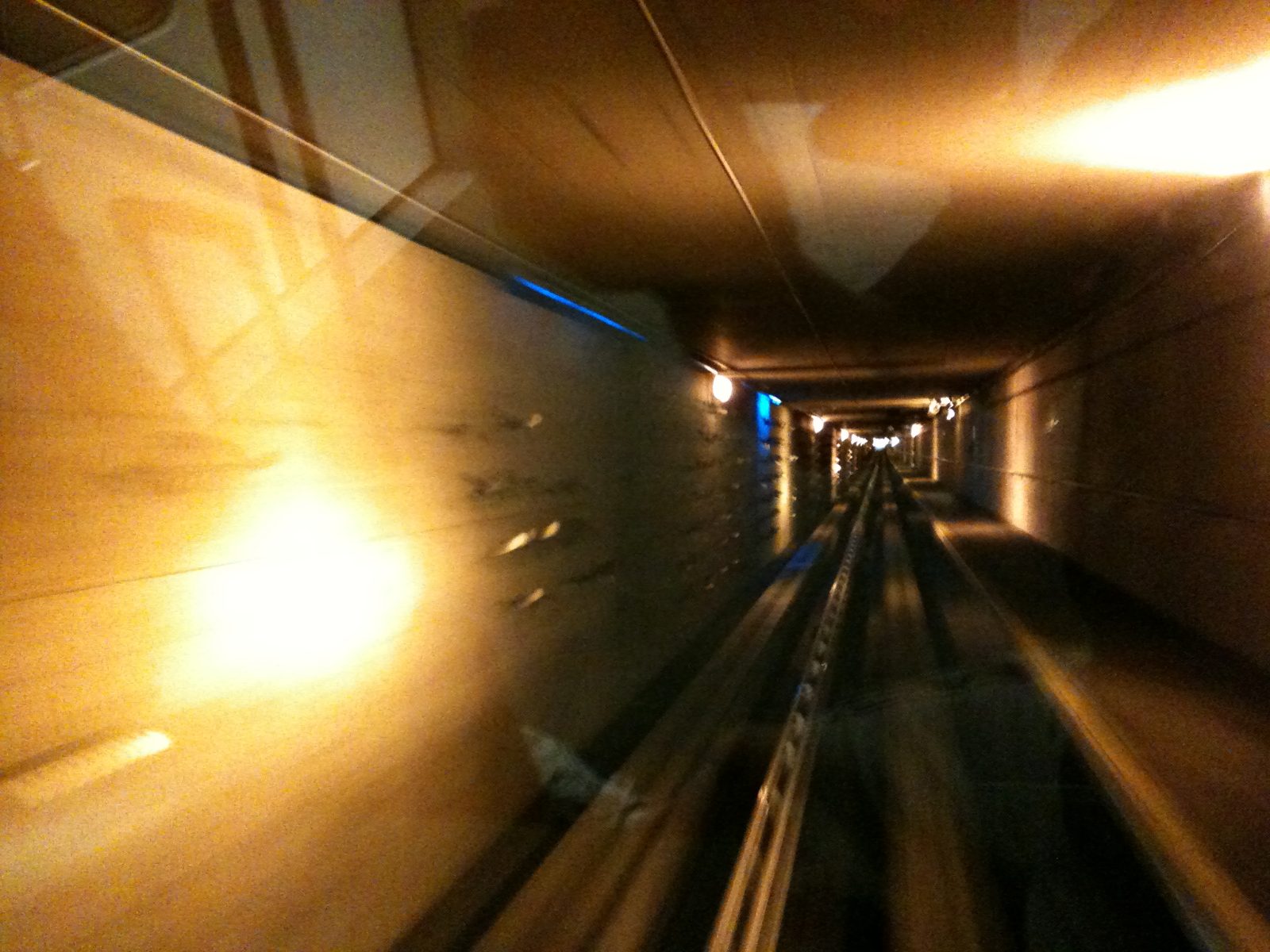
Once inside, most travelers will eventually ride the underground passenger train connecting Jeppesen Terminal with Concourses A, B, and C. This is where one of DEN's biggest conspiracy theories gets at least a little help from reality, because the airport does sit on a substantial amount of underground infrastructure.
Train tunnels, baggage systems, utility areas, and maintenance spaces all exist below ground, which over the years has helped fuel much bigger stories about military bunkers, survival shelters for the wealthy, New World Order command centers, and the reptilian bases that show up once you get deep enough into the forums. There has never been good evidence for the secret city part of the story, but the underground airport itself is real and much larger than the average passenger probably realizes.
While you are down there, look up from your phone for a minute. The train tunnel contains the Kinetic Air Light Curtain, an installation made from small propeller-like pieces that move and shimmer as passing trains push air through the tunnel. Other light and sound artwork was also designed to be experienced while moving through the underground system, turning a train ride most people barely notice into one of the more unusual parts of the airport.
The tunnels are about to become even more interesting because DEN has announced plans to convert portions of its former underground baggage system into pedestrian connections between Concourses A, B, and C, with construction expected to begin around 2027. After decades of stories about what might be hiding down there, parts of the old tunnel network could eventually become somewhere passengers walk through on the way to their gate.
Stop 3: The Great Hall and the New World Airport Commission
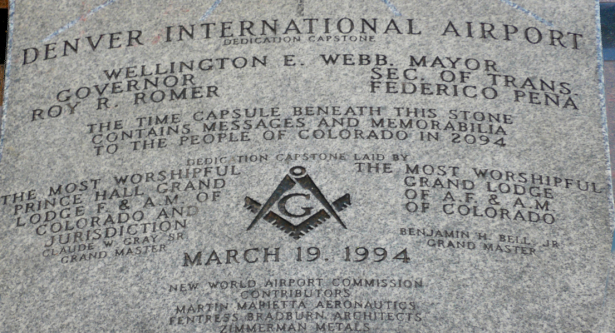
The Great Hall in Jeppesen Terminal is where several pieces of DEN conspiracy lore start overlapping, including one of the most famous artifacts in the airport: its dedication capstone and time-capsule marker.
Before you start searching the walls, look down. The marker is set into the floor and carries Masonic imagery, including the square-and-compass symbol, alongside a reference to something called the New World Airport Commission.
It is not difficult to understand why that particular combination got people's attention. The phrase became one of the main pieces used to connect DEN with New World Order theories, especially once the airport's murals, underground infrastructure, and other unusual artwork started generating theories of their own.
The documented history is considerably less mysterious. Masonic groups have participated in public building dedications for generations, while the New World Airport Commission was a local civic group connected to the opening of the new airport. None of that changes the fact that the marker is real, though. DEN does have Masonic imagery, and “New World Airport Commission” is written beneath it, which is probably why this particular theory has stuck around for so long.
Construction note. The Great Hall has undergone extensive reconstruction, changing passenger routes and portions of the flooring. Older sources place the capstone around the central north-south transition of the terminal, but its current visibility may depend on construction. If you are visiting now, do not count on directions leading you straight to it.
Stop 4: Look down for Au Ag
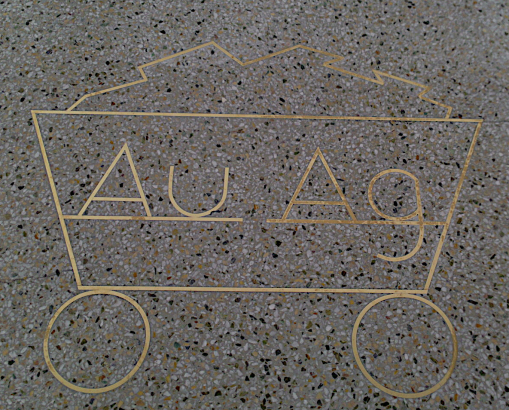
Since you are already looking at the floor, there is another detail worth searching for.
A mining-cart design incorporated into the Great Hall flooring contains the letters Au Ag, the chemical symbols for gold and silver. Considering Colorado's mining history and the fact that the letters appear with a mining cart, the intended reference is not especially hard to follow.
That did not stop another interpretation from taking hold. Some conspiracy theories connect Au Ag to Australian antigen, an older term associated with hepatitis B research, then continue from there into theories involving biological warfare and population control. The mining context tends to receive considerably less attention in those versions of the story, despite being right there around the letters.
The piece has historically been described as part of the Great Hall floor, although the ongoing reconstruction makes its exact current position harder to pin down with confidence. Keep an eye out for it, but be skeptical of any current guide that gives you a precise tile or door number without accounting for how much this area has changed.
Stop 5: Find the gargoyles
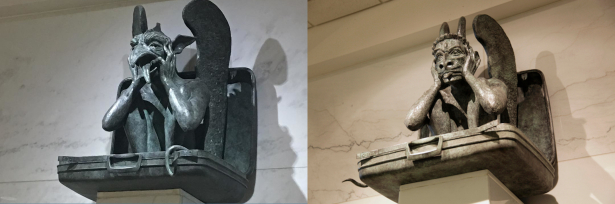
The gargoyles are much easier because we know exactly where to send you.
Officially called Notre Denver, Terry Allen's artwork consists of two bronze gargoyles sitting inside open suitcases above the baggage-claim area. DEN's explanation is that gargoyles traditionally served as protectors, so these two are watching over passengers' luggage. Putting gargoyles inside an airport already associated with Masons, underground bunkers, and apocalyptic murals naturally resulted in some less cheerful interpretations too.
To find them, take the train into Jeppesen Terminal and follow the signs toward Level 5 baggage claim. DEN uses odd-numbered exterior doors on the east side and even-numbered doors on the west, which makes the directions fairly easy to follow.
- East gargoyle: Level 5, east baggage claim, between exterior Doors 507 and 509. Look above normal eye level for the bronze figure sitting inside a suitcase.
- West gargoyle: Level 5, west baggage claim, between exterior Doors 506 and 508.
They are easy to miss if you are not looking for them because most people arriving at an airport are understandably more concerned with finding their luggage than checking the walls for gargoyles. Once you know the door numbers, though, these are probably the easiest conspiracy landmarks at DEN to track down.
The Tanguma murals
This is the part worth knowing before you follow an old YouTube video or Reddit thread around Level 5, because only one of Denver's famous conspiracy murals is back on display.
The two works by Leo Tanguma are Children of the World Dream of Peace and In Peace and Harmony with Nature, and the imagery that made them famous online is as unusual as the photos suggest. There is warfare, a towering military figure wearing a gas mask, weapons, frightened and grieving children, dead and endangered animals, and scenes of environmental destruction.
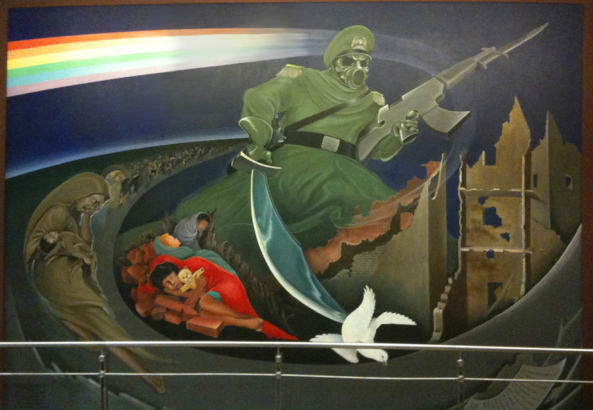
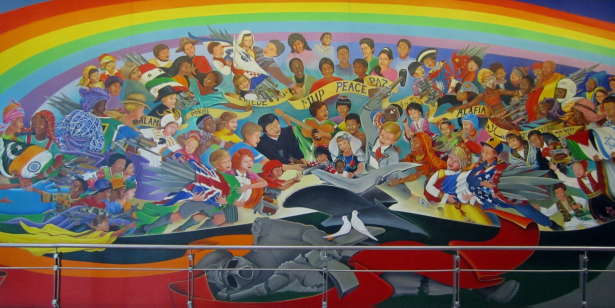
If you only see those portions, it is easy to understand how the paintings ended up connected to theories about genocide, biological warfare, population control, and the New World Order. The full murals tell a longer story, though, moving from violence and environmental destruction toward peace, cooperation, and restoration. The gas-masked soldier is part of what the painting's children eventually overcome rather than some vision of the future they are marching toward, which is an important bit of context that disappears when a single panel gets passed around online.
Their old location probably helped the rumors just as much as the imagery did. The murals were displayed along the broad Level 5 baggage-claim corridors on the east and west sides of the Great Hall, with In Peace and Harmony with Nature associated with the west side and portions of the works divided around doorways.
That meant you could get off a perfectly normal flight, head down to collect your luggage, and find yourself standing in front of a huge gas-masked soldier surrounded by scenes of destruction. Even knowing what Tanguma intended, it is a memorable choice of scenery for baggage claim.
Can you see Denver Airport's famous conspiracy murals today?
One of them. On August 10, 2026, DEN announced that In Peace and Harmony with Nature had gone back up the previous week on Level 5, Northwest, after several years in storage during the Great Hall construction. DEN's art listing places it near Door 504. Children of the World Dream of Peace, which moves from the devastation of war to children celebrating peace, is still in storage, and DEN says it will return once construction is completed.
If you find an older guide telling you exactly where to see both murals on Level 5, only the directions to In Peace and Harmony with Nature will lead you to a painting today.
The strange writing in the floor
Some of the less famous DEN theories involve inscriptions incorporated into the airport flooring, which have occasionally been presented online as strange symbols, secret messages, or some kind of occult language.
Several of the examples that circulate most often are Navajo words and place references connected to the geography and Indigenous history of the region. Older discussions include wording associated with silver or white metal, White Mountain, a river name, and Blanca Peak, a mountain with significance in Navajo tradition.
Translations and spellings vary enough across old blogs and reposted photos that it is worth being cautious about treating any random internet transcription as authoritative. What is interesting is how quickly an unfamiliar inscription can change once the photo loses its original context, especially after the same image has bounced between forums, videos, and social posts for years and a regional reference starts being presented as evidence of a secret language hidden throughout the airport.
Things you have seen online that are not permanent DEN landmarks
Not everything that appears in Denver Airport conspiracy videos is still waiting for you when you arrive. A few of the stranger images circulating online came from temporary installations or publicity stunts that have since disappeared.
The giant Anubis statue. The photos are real. A massive statue of the Egyptian god Anubis did stand at DEN, although it was not part of the airport's original architecture or a permanent installation. It was placed there temporarily as promotion for a traveling King Tut exhibition and was later removed.
The talking gargoyle. This one was real too, but it should not be confused with Terry Allen's permanent bronze gargoyles. DEN once used a talking gargoyle that interacted with travelers as a publicity stunt playing off the airport's own conspiracy reputation. The two gargoyles you can find today are considerably less talkative.
The viral resurfacing cycle. Old DEN photos have a habit of coming back every few years on Reddit, TikTok, and YouTube with very little context, which is why temporary installations sometimes get mistaken for permanent airport features. Before adding something to your list, it is worth checking whether the object is still there, used to be there, or was only around long enough for somebody to take the photo you keep seeing.
The runways
One of the oldest DEN theories is also something you cannot investigate from inside the airport: the claim that its runway layout resembles a swastika when viewed from above.
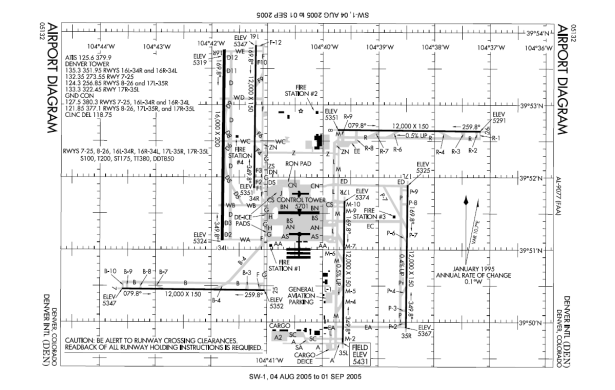
The angular, pinwheel-like arrangement is real and easy enough to see on satellite imagery. Airport planners have a much more practical reason for layouts like this, since separating runways and orienting them in different directions allows aircraft to operate with changing wind conditions while reducing intersecting traffic.
Whether the resemblance jumps out at you is probably something to decide after pulling up the satellite view yourself. Either way, there is no point wandering the terminal trying to find a good angle because this one only exists from above.
Further investigation and your self-guided route
DEN is still changing, which means this route will change with it. The Great Hall reconstruction affects access to some of the floor pieces, Children of the World Dream of Peace is expected to return once construction is complete, and the old baggage tunnels could eventually become publicly accessible pedestrian connections.
If you are passing through now, this is the easiest order to follow:
- Before reaching the terminal, watch for Blucifer along Peña Boulevard, especially if you are arriving after dark.
- On the underground train, look for the Kinetic Air Light Curtain and other tunnel artwork.
- In the Great Hall, look down for the New World Airport Commission capstone and the Au Ag mining-cart design if construction allows access.
- Head to Level 5 east baggage claim and find the gargoyle between Doors 507 and 509.
- Cross to the west side for the second gargoyle between Doors 506 and 508.
- On the same west side of Level 5, near Door 504, find In Peace and Harmony with Nature. Children of the World Dream of Peace is still in storage and is expected to return after the Great Hall work is finished.
Denver International is one of those rare conspiracy locations where you do not have to imagine much of the setup. There is a giant blue horse with red eyes on the drive in, gargoyles watching baggage claim, Masonic imagery in the floor, strange artwork underground, and a pair of murals famous enough that people still go looking for the one that is in storage.
Featured Places
Comments
0 on the record
- No comments yet. Be the first witness.